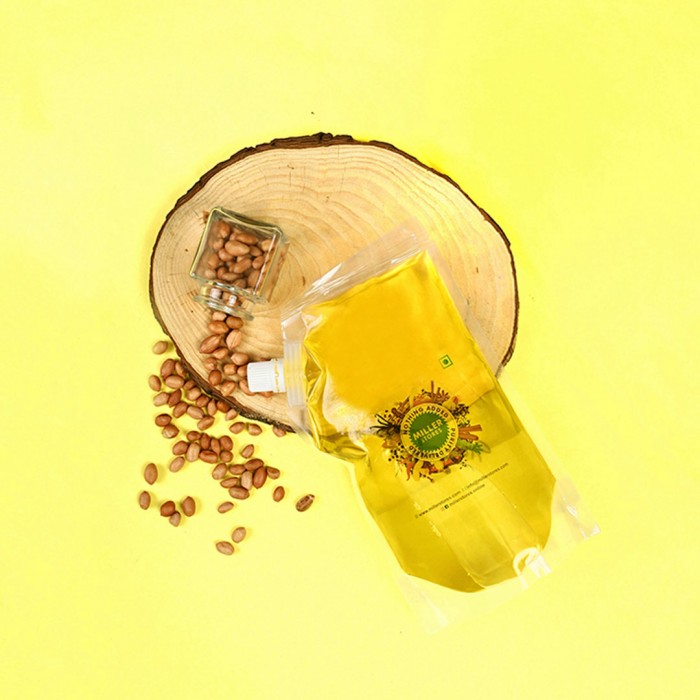
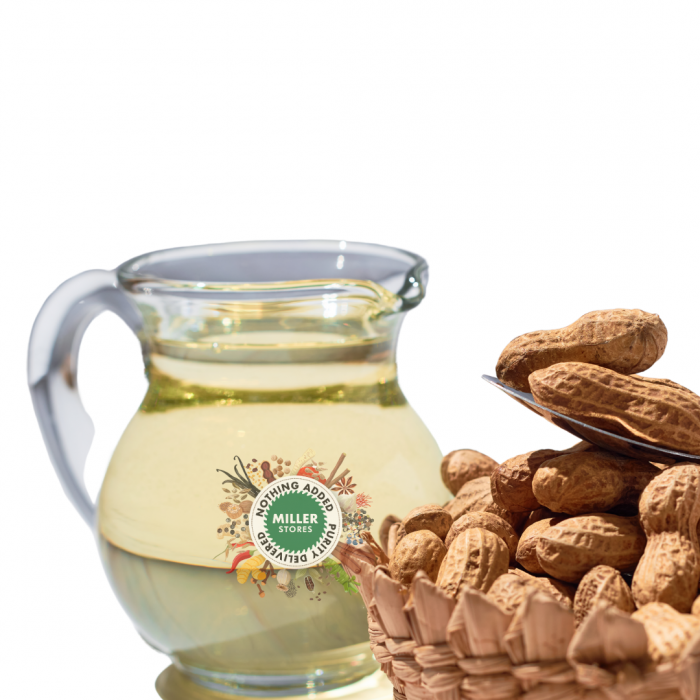


COLD PRESSED GROUNDNUT OIL
Description
Miller Stores’ Cold Pressed Groundnut Oil is freshly extracted from handpicked peanuts, ensuring a robust, nutty aroma. This unrefined oil is ideal for stir-frying, deep-frying, and salad dressings, adding a rich taste to your dishes. Enjoy a healthier alternative to refined oils, loaded with vitamins and antioxidants.
Internal Reference:
online-productcoldoilpressed
Cold Pressed Groundnut Oil — Milled Fresh, Unrefined
Cold pressed groundnut oil, crushed from whole shelled groundnuts in a wooden-barrel rotary press and filtered only through cloth. Nothing is heated, bleached or deodorised, which is why it still smells of roasted peanut. We press in small batches because unrefined oil is best used within a few months, not stored for a year.
How we make it
Shelled groundnuts are cleaned, sun-dried to the right moisture and fed into a slow wooden chekku press. The pestle turns at low speed so the temperature in the barrel stays around 40-45°C — the point of cold pressing is that the oil never gets hot enough to lose its aroma compounds or its vitamin E. The first run of oil is cloudy; it settles for two days, then passes through a cloth filter. No solvent, no caustic wash, no clay bleaching, no steam deodorising. Roughly three kilos of groundnut yield one litre of oil, which is the honest reason cold pressed oil costs more than refined.
What goes in, what stays out
One ingredient: groundnuts. No refined oil blended in, no antioxidant preservative such as TBHQ, no added vitamins to replace ones stripped out, no anti-foaming agent. The oil-cake left after pressing goes to cattle feed, not back into the bottle.
How to use it
- Everyday South Indian tempering — the aroma survives the tadka in a way refined oil cannot
- Andhra and Tamil cooking where groundnut is the traditional fat
- Shallow frying and sautéing at medium heat
- Chutney podi and pickle, where the oil carries the flavour
- Oil pulling and body massage, since it is food-grade and unrefined
How to store it
Keep the bottle capped, away from the hob and out of direct sun. It does not need refrigeration. Use within about six months of pressing — unrefined oil has no synthetic antioxidant, so it is meant to be used, not stored. A little sediment at the bottom is ground groundnut solids and is normal.
What it is called
| Language | Name |
|---|---|
| Tamil | Kadalai ennai |
| Telugu | Palli nune |
| Malayalam | Kappalandi enna |
| Hindi | Moongphali tel |
| Kannada | Shenga enne |
Where to buy it
Milled to order at our Kondapur and Serilingampally stores in Hyderabad, or shipped across India. Browse the rest of our Freshly Extracted Oil range, or see cold pressed sesame oil and cold pressed coconut oil. If you want the background, read how to spot adulterated spice at home.
Frequently asked questions
What is the difference between cold pressed, wood pressed and refined groundnut oil?
Cold pressed and wood pressed mean the same thing in practice: the nut is crushed slowly at low temperature and filtered. Refined oil is extracted with heat or solvent, then bleached and deodorised. Refining raises the smoke point and removes the smell, along with most of the aroma and vitamin E.
Why does your groundnut oil smell so strongly of peanut?
Because nothing was done to remove that smell. Deodorising is a specific step in refining that strips the volatile aroma compounds. An unrefined groundnut oil that smells of nothing has usually been refined and relabelled.
Can I deep fry in cold pressed groundnut oil?
Yes. Groundnut oil has one of the higher smoke points among unrefined oils, around 160-180°C, which covers most Indian deep frying. Do not reuse it more than twice, and never heat it to smoking — that destroys the oil and the flavour.
Is the cloudy sediment at the bottom of the bottle a problem?
No. It is fine groundnut solids that pass through a cloth filter. Refined oils look perfectly clear because they are filtered through bleaching clay. Shake the bottle before use, or let it settle and pour off the clear oil.
How is this different from the groundnut oil in a supermarket?
Most supermarket groundnut oil is solvent-extracted and refined, which gives a longer shelf life and a neutral taste. Ours is mechanically pressed and filtered only. That is the whole difference, and it is why the price and the smell are both higher.
Do you press the oil in store, and can I watch?
Yes. The press runs at our Kondapur and Serilingampally counters and you are welcome to stand and watch it. Most people who buy unrefined oil for the first time do exactly that.



EXPLORE MORE FROM MILLER STORES
![[online-productFLOUR_RAGI_] RAGI FLOUR](/web/image/product.product/3570/image_512)
![[online-productPUMPKIN-SEEDS] PUMPKIN SEEDS](/web/image/product.product/3569/image_512)
![[online-productMASALA_KOLLAM FISH_] Pepper Fish Fry Masala Mix](/web/image/product.product/3568/image_512)
![[online-productCHIASEEDS] CHIASEEDS](/web/image/product.product/3565/image_512)
![[online-productSPICE_SAFFRON PREMIUM_] SAFFRON PREMIUM](/web/image/product.product/3551/image_512)
![[online-productSPICE_SAUNF_] SAUNF](/web/image/product.product/3550/image_512)
![[online-productPOWDER_SAMBAR_] SAMBAR POWDER](/web/image/product.product/3549/image_512)
![[online-productMIX_SAMBAR_] INSTANT SAMBAR POWDER](/web/image/product.product/3548/image_512)
![[online-productRICE_RED_] RED RICE](/web/image/product.product/3545/image_512)
![[online-productSNACKS_POTATO_] POTATO FLAKES](/web/image/product.product/3537/image_512)
![[online-productSALT_PINK FINE_] PINK SALT FINE](/web/image/product.product/3534/image_512)
![[online-productSALT_PINK COARSE_] PINK SALT COARSE](/web/image/product.product/3533/image_512)
![[online-productSUGAR_PALM NATURAL_] PALM SUGAR NATURAL](/web/image/product.product/3531/image_512)
![[online-productSPICE_NUT MEG_] NUT MEG](/web/image/product.product/3529/image_512)