Ragi simili urundai is a ragi and sesame laddu bound with jaggery. Cook ragi flour dough into two rotis, cool and grind them to crumbs, then mix with ground roasted peanuts, roasted sesame, cardamom and jaggery paste, and shape into small balls. Plan on about 45 minutes, and keep the laddus refrigerated for up to 3 days.
Recipe by @shashisadukkala47. Page edited by The MILLERS, Miller Stores. Last updated 4 October 2026.
Key takeaways
- The base is ragi roti, not raw flour: the rotis are cooked, cooled and ground, so the laddu has no raw-flour taste.
- The recipe uses 1/2 cup ragi flour, 1/4 cup roasted peanuts, 1 tbsp roasted sesame and 5 tbsp grated jaggery.
- Use ghee only to cook the roti and to bind the mix; do not add water to the laddu mixture.
- The original recipe stores them in the fridge for up to 3 days, so make small batches.
- Ragi is unusually rich in calcium for a cereal, but these laddus are still a sweet treat, not a medicine.
What do you need to make ragi simili urundai?
You need eight ingredients, and most are pantry staples. Quantities below are from the original recipe by @shashisadukkala47. For freshly milled flour, use our Ragi Flour (stone ground from whole finger millet).
| Ingredient | Quantity | Role in the laddu |
|---|---|---|
| Ragi flour (finger millet) | 1/2 cup | Base for the rotis |
| Roasted peanuts | 1/4 cup | Crunch; ground coarsely |
| Roasted white sesame seeds | 1 tbsp | Nutty flavour |
| Grated jaggery | 5 tbsp | Sweetener and binder, blended to a smooth paste |
| Ghee (Miller Stores Ghee) | 1 tbsp in total | 1 tsp on the rotis, 1/2 tbsp in the mix |
| Cardamom powder (grind seeds from whole green cardamom) | 1/4 tsp | Aroma |
| Salt | 1/4 tsp | Balances the sweetness |
| Water | As needed | To knead the roti dough only |
How do you make ragi simili urundai, step by step?
Make the rotis first, cool them fully, then grind and mix. The whole process takes about 45 minutes including cooling.
- Make the dough (5 minutes). Mix 1/2 cup ragi flour with 1/4 tsp salt. Add water a little at a time and knead to a soft, non-sticky dough.
- Roll two rotis (5 minutes). Divide the dough into two equal portions and roll each into a slightly thick roti.
- Cook the rotis (about 6 to 8 minutes). Heat a tawa on medium heat. Cook each roti on both sides, brushing 1 tsp ghee in total while cooking, until it is cooked through and lightly browned.
- Cool completely (15 to 20 minutes). Do not grind warm rotis; they turn pasty. Tear the cooled rotis into small pieces.
- Grind the rotis. Pulse the pieces in a mixer jar to a coarse powder. Transfer to a bowl.
- Grind the peanuts and jaggery. Coarsely grind 1/4 cup roasted peanuts and set aside. Blend 5 tbsp grated jaggery to a smooth paste.
- Combine. To the roti powder add the peanuts, 1 tbsp roasted sesame, 1/4 tsp cardamom powder and 1/2 tbsp ghee. Add the jaggery paste and mix until the mixture holds together when pressed.
- Pulse and shape. Return everything to the mixer jar and pulse twice. Shape the mixture into small laddus with your palms.
Is ragi good for you, and what does the science say?
Ragi (finger millet) is noted for its calcium content. A 2017 review in Frontiers in Plant Science calls it "the richest source of Ca among all the cereals" and lists 344 mg of calcium per 100 g of finger millet, against 41 mg for wheat and 33 mg for brown rice [1]. The FAO's review of millets in human nutrition says that, apart from very high calcium and manganese, the mineral composition of finger millet is comparable to sorghum [2].
These figures are for the raw grain. This page makes no claim about how much calcium your body absorbs from a laddu, and it does not suggest ragi treats or prevents any condition. The laddus also contain jaggery and ghee, so treat them as a sweet snack. If you manage blood sugar or a dairy or nut allergy, check with your doctor before eating them.
What do we see in ragi flour at our counter?
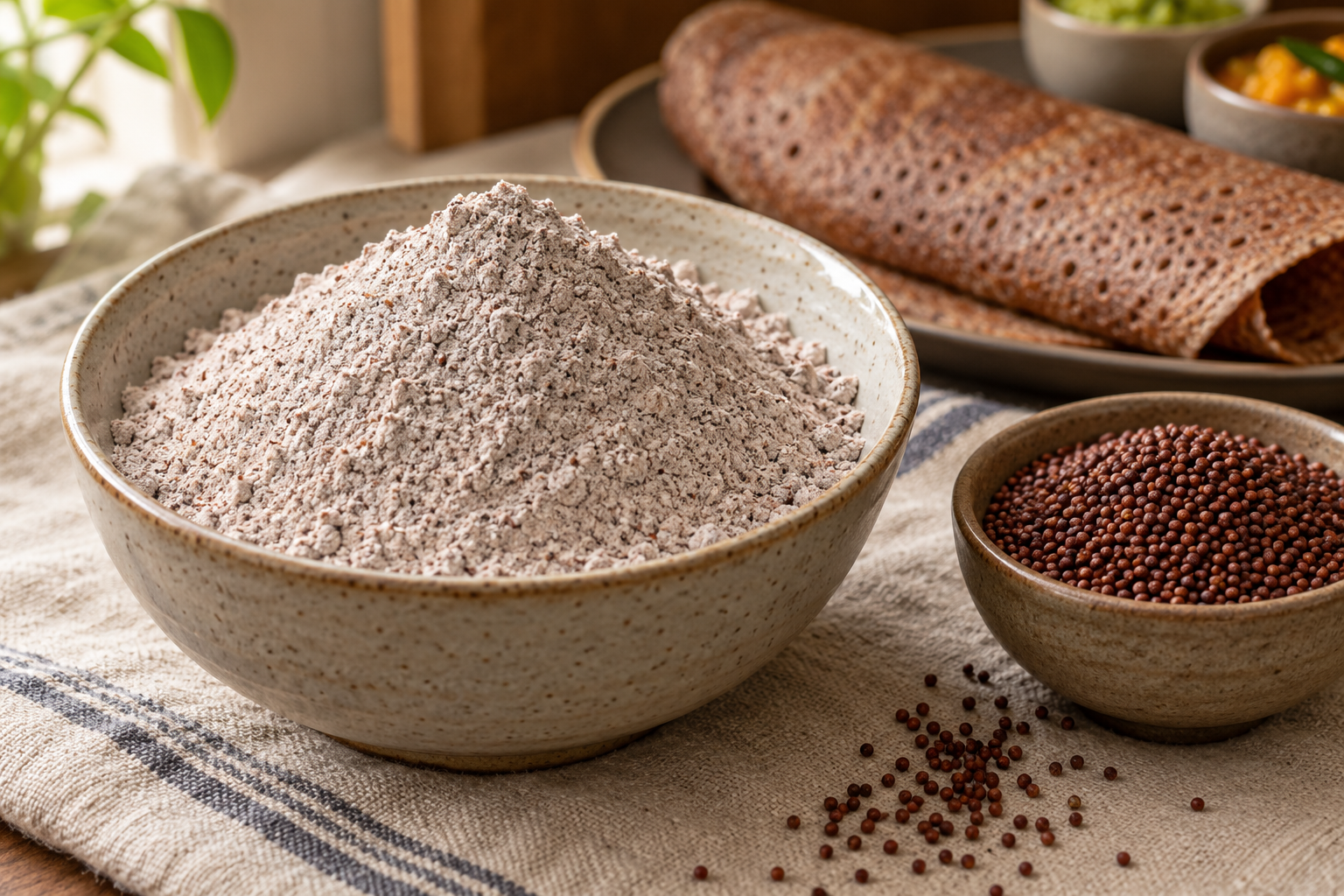
Our ragi flour is stone ground to order from whole finger millet, with the bran and germ left in, so it is the natural greyish-brown of ragi rather than a pale, sifted flour. It is a single ingredient: no maida or rice flour is cut in, and nothing is bleached. We mill it at our Kondapur and Serilingampally stores in Hyderabad, and we ship it across India. Because the germ carries oil, keep the flour airtight, cool and dark and use it within four to six weeks, or two to three months in the fridge. Browse the rest of our freshly milled flours.
How do you store ragi simili urundai?
Store the laddus in the refrigerator for up to 3 days, as the original recipe advises. Make smaller batches for the best freshness, and keep them in a closed container so they do not dry out or pick up fridge smells.
Why are my ragi laddus crumbly, hard or sticky?
| Problem | Likely cause | Fix |
|---|---|---|
| Laddus fall apart | Not enough binder, or the jaggery paste is too thick | Add 1 tsp warm ghee or a little more jaggery paste, mix and pulse again |
| Mixture is sticky or too soft | Too much jaggery paste, or rotis ground while warm | Add a spoon of roti powder, or rest the mixture in the fridge for 10 minutes before shaping |
| Laddus feel hard | Rotis overcooked and dry | Cook rotis only until done and brown lightly; add a little ghee when mixing |
| Gritty texture | Jaggery not blended smooth | Grate the jaggery finely and blend to a paste before mixing |
Frequently asked questions
What is ragi simili urundai?
Ragi simili urundai is a traditional laddu made from ragi (finger millet) with peanuts, sesame and jaggery. In this recipe the ragi is first made into rotis, which are cooled and ground, then mixed with the other ingredients and shaped by hand into small balls.
Can I use jaggery powder instead of grated jaggery?
Yes. Jaggery powder blends in more easily, so you can skip making a paste and mix it straight into the roti powder. Start with 5 tbsp and adjust to taste. Our guide to jaggery powder, palm sugar and coconut sugar explains how the sweeteners differ.
Can I make these laddus without peanuts?
Yes, if you have a peanut allergy or simply prefer to leave them out. The laddus will be softer and less crunchy, and you may need a little extra ghee to bind the mixture. You can add more roasted sesame instead, since the recipe already uses it.
How long do ragi laddus last?
The original recipe stores them in the refrigerator for up to 3 days, and recommends making smaller quantities for maximum freshness. Keep them in a closed container, and throw them away if they smell off or show any mould. For longer gaps between batches, halve the quantities rather than stretching the storage time.
Why use roti instead of raw ragi flour?
Cooking the flour as roti and then grinding it removes the raw taste of uncooked ragi flour and gives a crumbly base that binds well with jaggery. If you want more ways to use ragi flour, see our ragi flour breakfast recipes.
Cooking with other millets
Ragi (finger millet) is only one of India's traditional millets. If you're working with foxtail, barnyard, kodo or little millet, see our millet water ratio and cooking-time guide for how much water each one needs.
Where can you buy the ingredients?
Get Ragi Flour, Ghee and whole green Cardamom from Miller Stores, or browse all our freshly milled flours.
Sources
- Frontiers in Plant Science. Harnessing Finger Millet to Combat Calcium Deficiency in Humans: Challenges and Prospects (2017). pmc.ncbi.nlm.nih.gov
- FAO. Sorghum and millets in human nutrition (finger millet section). fao.org
Recipe quantities and the 3-day storage advice are from the original recipe by @shashisadukkala47. Nutrition figures are for raw grain and are not medical advice.