Ceylon cinnamon is thin bark hand-rolled into a soft quill of many layers that snaps easily. Cassia — most "cinnamon" sold in India — is one thick, hard curl. They're legally different spices here, and cassia naturally carries far more coumarin, a compound FSSAI caps by law in real cinnamon but not in cassia.
The short version
- Look at the roll. Ceylon is many thin layers rolled like a cigar. Cassia is one thick, woody curl.
- Try to snap it. Ceylon crumbles between your fingers. Cassia needs a hammer or mortar.
- This only works on whole sticks. Once either one is ground to powder, you cannot tell them apart by eye.
- Cassia is not "impure" cinnamon — it's a different spice that Indian food law defines and standards separately from true cinnamon.
- Cassia has roughly 100 times more coumarin than Ceylon on average, which is why FSSAI sets a legal coumarin ceiling for cinnamon but not for cassia.
- A home test can't measure coumarin content. For an actual number in parts per million, you need a lab.
What's actually different between Ceylon cinnamon and cassia?
Ceylon cinnamon — Cinnamomum verum, still called Cinnamomum zeylanicum in Indian food law — is the inner bark of a tree native to Sri Lanka and South India, peeled by hand, scraped thin, and rolled while still soft into a multi-layered quill. Cassia is the bark of a different, related tree: Cinnamomum cassia, or the closely related C. aromaticum, C. burmannii and C. loureiroi, native mainly to China, Indonesia and Vietnam. Its bark is thicker and coarser, so it dries into one hard curl rather than layers.
India's food regulator, FSSAI, does not treat these as one spice in two grades. The Food Safety and Standards (Food Products Standards and Food Additives) Regulations, 2011 define Cinnamon (Dalchini) under regulation 2.9.4 as bark specifically from Cinnamomum Zeylanicum, and Cassia (Taj) under 2.9.5 as bark from the cassia species named above — two different regulated products, each with its own compositional standard.[1] Selling cassia labelled as cinnamon is a labelling problem under Indian law, not just a quality one.
In November 2023, FSSAI told food safety commissioners across every state to run a market surveillance drive specifically on this, after receiving complaints that cassia (Taj) was being sold and mislabelled as cinnamon (Dalchini) to capture cinnamon's higher price.[2]
How can you tell which one you have?
This works reliably only on whole sticks — buy whole and check for yourself, since powder hides everything.
- Look at a cut end. Ceylon shows several thin sheets rolled together, like a cigar or a scroll of paper — you can count the individual layers. Cassia shows one thick wall of bark curled from both sides toward the middle, with no layering.
- Try to snap or crumble it. Ceylon is brittle and soft enough to crumble between your fingers. Cassia is dense and woody — you need a mortar or a knife to break it.
- Check the colour. Ceylon is light tan to pale brown. Cassia is darker, redder-brown.
- Compare the price. Ceylon costs several times more than cassia to produce, because the inner bark has to be peeled and scraped by hand rather than simply stripped. A cinnamon priced like a common spice, in India, is almost always cassia.
- Read the label. Under Indian law the two are supposed to be named correctly — look for "Cinnamomum verum," "Cinnamomum zeylanicum," or "Ceylon cinnamon" specifically, not just "cinnamon" or "dalchini."
| Ceylon cinnamon (Dalchini) | Cassia (Taj) | |
|---|---|---|
| Species | Cinnamomum verum / zeylanicum | C. cassia, C. aromaticum, C. burmannii, C. loureiroi |
| Structure | Many thin layers, rolled like a scroll | One thick curl, no layers |
| Texture | Brittle, crumbles by hand | Hard, woody, needs a tool to break |
| Colour | Light tan to pale brown | Darker, reddish-brown |
| Flavour | Delicate, sweet | Strong, sharp, more pungent |
| Coumarin (typical) | Trace to ~0.19 g/kg | Roughly 0.7–12.2 g/kg |
Coumarin ranges from Miller et al. (1995), as cited in BfR Health Assessment No. 043/2006 — see Sources.
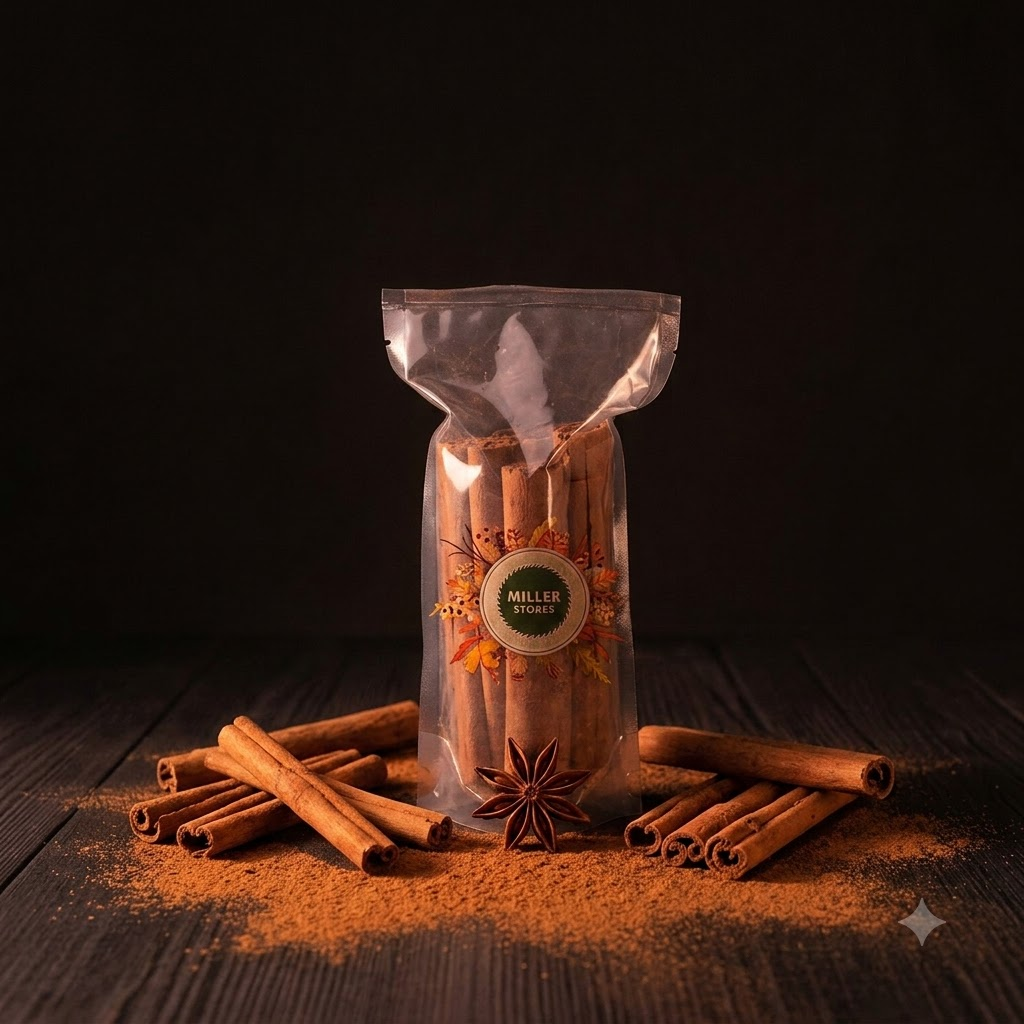
Does the coumarin difference actually matter?
Coumarin is a naturally occurring compound both types of cinnamon contain — cassia just contains a lot more of it. Ceylon cinnamon has "no (at most traces)" of it; cassia's bark measures anywhere from under 1 gram to over 12 grams per kilogram, depending on the species and batch.[3] The Austrian food safety agency AGES puts the gap at roughly a hundredfold.[4]
The reason it's regulated at all is the liver. EFSA's toxicology review set a tolerable daily intake (TDI) of 0.1 mg of coumarin per kilogram of body weight, based on hepatotoxicity — liver harm — seen in animal studies, a figure Germany's BfR has independently reviewed and found reasonable against human data on coumarin and liver enzyme changes.[3] For a 60 kg adult, that works out to about 6 mg a day, from all sources, for life, with no expected harm.
What that means in practice, worked out from the published ranges above: a rounded teaspoon of ground cassia (roughly 2.6 g) can contain anywhere from about 2 mg to 8 mg of coumarin, depending on the batch — which can sit right at or past that 6 mg daily figure for an average adult, if you ate that much every single day. The same teaspoon of Ceylon cinnamon, at its highest measured coumarin level, contains under half a milligram — you'd need well over a dozen teaspoons a day to reach the same limit.
That is not a reason to panic about a cassia-dusted cappuccino or a cinnamon stick simmered in one pot of biryani and removed before serving — occasional use, in ordinary cooking amounts, comes nowhere close to the TDI. It matters for daily, habitual, powdered use: a spoon of cassia in chai every morning, cinnamon capsules or supplements taken for blood sugar, or a household that goes through cassia powder heavily. BfR's own case study found that diabetics taking 6 g of cassia cinnamon a day in capsule form — a real supplement dose, not a cooking one — took in about three times the adult TDI.[3] Children are a separate case: AGES advises no more than about half a teaspoon (0.5 g) of cinnamon a day for children, since they weigh less and the same amount of coumarin counts for more per kilogram of body weight.[4]
This is why FSSAI's Cinnamon (Dalchini) standard sets a coumarin ceiling of not more than 0.3% by weight, for both whole and powdered cinnamon — and why the Cassia (Taj) standard, a genuinely different product under the law, carries no such ceiling at all.[1] The regulation exists specifically because cassia, sold under the cinnamon name, could otherwise put a habitual user's coumarin intake far higher than they'd expect from a jar labelled "cinnamon."
What a home test can't tell you
Be clear-eyed about the limits here, because this is a food-safety topic and not just a kitchen trick. Looking at a stick, snapping it and comparing colour will reliably tell you which bark you have, whole. What it cannot do:
- Give you a coumarin number. Measuring coumarin content in parts per million needs gas or liquid chromatography in a lab — there is no visual or kitchen test that produces a figure you can compare against the FSSAI or EU limits.
- Say anything about powder. Ground cinnamon and ground cassia are visually indistinguishable. If what you have is already powdered, the roll-shape and snap tests simply don't apply.
- Catch a blend. Cassia mixed into Ceylon powder, or vice versa, defeats both the eye test and the snap test.
- Substitute for a lab report. We don't currently publish a coumarin lab report for our own cinnamon — our lab reports page covers chilli today. If you need a verified figure rather than an informed estimate, a private food-testing lab is the only route.
What we stock, and why
Miller Stores sells Ceylon Cinnamon — true cinnamon, not cassia, and not a blend of the two. It's not graded or marketed as a "premium" version of the same spice; it's simply the other species, at the price hand-peeled bark actually costs. We don't stock a cassia product, so there's no cinnamon-vs-cassia decision to make at our counter — the decision we've already made is not to sell cassia labelled as cinnamon at all.
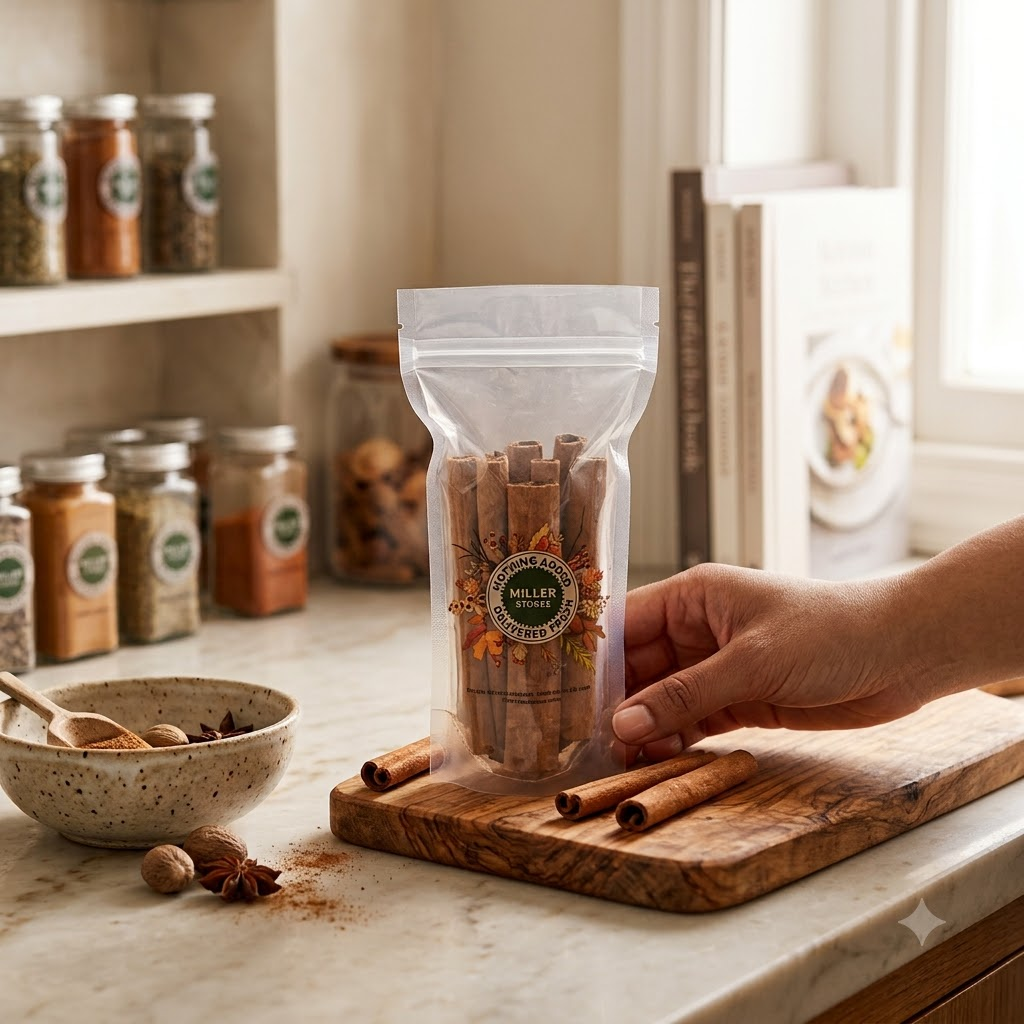
If you already have loose cinnamon sticks at home and want to check them against the real thing, the photo above and the cut-end test earlier on this page are exactly what our own stock looks like — many thin layers, rolled tight, snapping cleanly rather than needing a knife.
Where to buy it
Ceylon Cinnamon (whole quills) is milled to order at our Kondapur and Serilingampally stores in Hyderabad, or shipped across India. Browse the rest of our Whole Spices range, or see whole black pepper. For the wider purity picture, read how to spot adulterated chilli powder, turmeric and coriander at home.
Frequently asked questions
Is my cinnamon real Ceylon, or is it cassia?
If it's a whole stick, check the cut end: many thin layers rolled together and a texture that crumbles by hand is Ceylon; one thick, hard curl is cassia. If it's already ground, you cannot tell by eye — check the label for "Cinnamomum verum" or "Ceylon cinnamon" specifically, since plain "cinnamon" on an Indian shelf is usually cassia.
How can I tell Ceylon cinnamon from cassia without a lab test?
Look at a cut cross-section for layering, try to snap or crumble the stick, and compare colour and price. All four together are reliable on whole sticks. None of them work on powder, and none of them can tell you an actual coumarin level — that needs a lab.
Is cassia cinnamon unsafe to eat?
Not in ordinary cooking amounts. The concern is daily, heavy, powdered intake — cassia contains roughly a hundred times more coumarin than Ceylon on average, and EFSA's tolerable daily intake for coumarin (0.1 mg per kg body weight) can be approached by a teaspoon of cassia eaten every day. A stick simmered in one dish, or an occasional dusting, is not a meaningful exposure.
Why does India have a legal coumarin limit for cinnamon but not cassia?
Because FSSAI defines Cinnamon (Dalchini) and Cassia (Taj) as two separate regulated products under the Food Safety and Standards (Food Products Standards and Food Additives) Regulations, 2011. Only the cinnamon standard carries a coumarin ceiling — not more than 0.3% by weight — specifically to stop cassia being sold under the cinnamon name.
Can I tell Ceylon cinnamon and cassia apart once they're ground into powder?
Not reliably by eye, colour or smell alone — this is exactly why FSSAI's advisory covers powdered as well as whole cinnamon. If purity matters to you, buy whole sticks and grind them yourself, or buy powder only from a source willing to state the species on the label.
Is Ceylon cinnamon worth the extra price over cassia?
The price gap is mostly labour — Ceylon bark is hand-peeled and scraped thin, cassia bark is simply stripped and dried. Whether it's "worth it" depends on your use: for daily habitual intake, the far lower coumarin content is a real practical reason to prefer it; for occasional cooking, it's mainly a matter of the softer, sweeter flavour.
How much cassia cinnamon is too much in a day?
There's no single safe number we can give you, since coumarin content varies by batch and this isn't medical advice. As a general reference point, EFSA's tolerable daily intake is 0.1 mg coumarin per kg body weight — for a 60 kg adult, about 6 mg a day for life. Published measurements put a teaspoon of cassia anywhere from roughly 2 to 8 mg of coumarin, so daily habitual use can approach or exceed that figure; occasional use in cooking does not.
What is Ceylon cinnamon called in Indian languages?
Cinnamon in general is dalchini in Hindi, karuvapatta in Malayalam, lavanga pattai in Tamil, dalchina chekka in Telugu and chakke in Kannada. None of these words distinguish Ceylon from cassia on their own — under FSSAI's regulations, "dalchini" specifically means true cinnamon, while cassia is separately named "taj."
Sources
- Food Safety and Standards Authority of India. Food Safety and Standards (Food Products Standards and Food Additives) Regulations, 2011 (as amended), regulations 2.9.4 (Cinnamon/Dalchini) and 2.9.5 (Cassia/Taj). Hosted via FAO FAOLEX: faolex.fao.org
- FSSAI. Letter regarding market surveillance to check adulteration of Cassia (Taj) in Cinnamon (Dalchini) and misbranding of such food products, File No. RCD-02001/2/2021-Regulatory-FSSAI-Part(1), November 2023. fssai.gov.in
- German Federal Institute for Risk Assessment (BfR). Consumers who eat a lot of cinnamon currently have an overly high exposure to coumarin, BfR Health Assessment No. 043/2006 (16 June 2006). bfr.bund.de
- Austrian Agency for Health and Food Safety (AGES). Coumarin. ages.at
This is general food-safety information, not medical advice. The visual and physical checks above are indicative only — they identify which bark you have, not its exact coumarin content, and cannot detect a blend or confirm anything once cinnamon is ground. For a definitive coumarin figure, use an accredited food-testing lab.