Most homemade sambar powder recipes use roughly equal parts dried red chilli and coriander seed, with smaller measures of dal and fenugreek added for body and roundness. There is no single correct ratio - it varies by family and region - but the pattern across published recipes is consistent enough to chart.
- Coriander seed and dried red chilli are the two highest-volume ingredients in almost every recipe we checked, usually close to a 1:1 ratio by weight.
- Dals (toor, chana, urad) are added in much smaller amounts - roughly a tenth to a quarter of the coriander quantity - mainly for body and a rounder mouthfeel, not heat or aroma.
- Fenugreek is used sparingly. Too much and the whole batch turns bitter.
- Kerala home cooking often skips a stored "sambar podi" altogether, grinding spices fresh with curry leaf, and sometimes coconut, instead of keeping a jar on the shelf.
- Every source we checked - food writers, a Kerala-based home cook and Miller Stores' own kitchen - says the same thing: the ratio is a household habit, not a fixed formula.
What's the actual ratio of ingredients in sambar powder?
Coriander seed and dried red chilli carry most of the weight in a batch of sambar powder, usually in a ratio close to 1:1. Everything else - the dals, the fenugreek, the turmeric - is added in much smaller amounts to round out the flavour and thicken the finished dish slightly. Here is what five published recipes actually use, side by side:
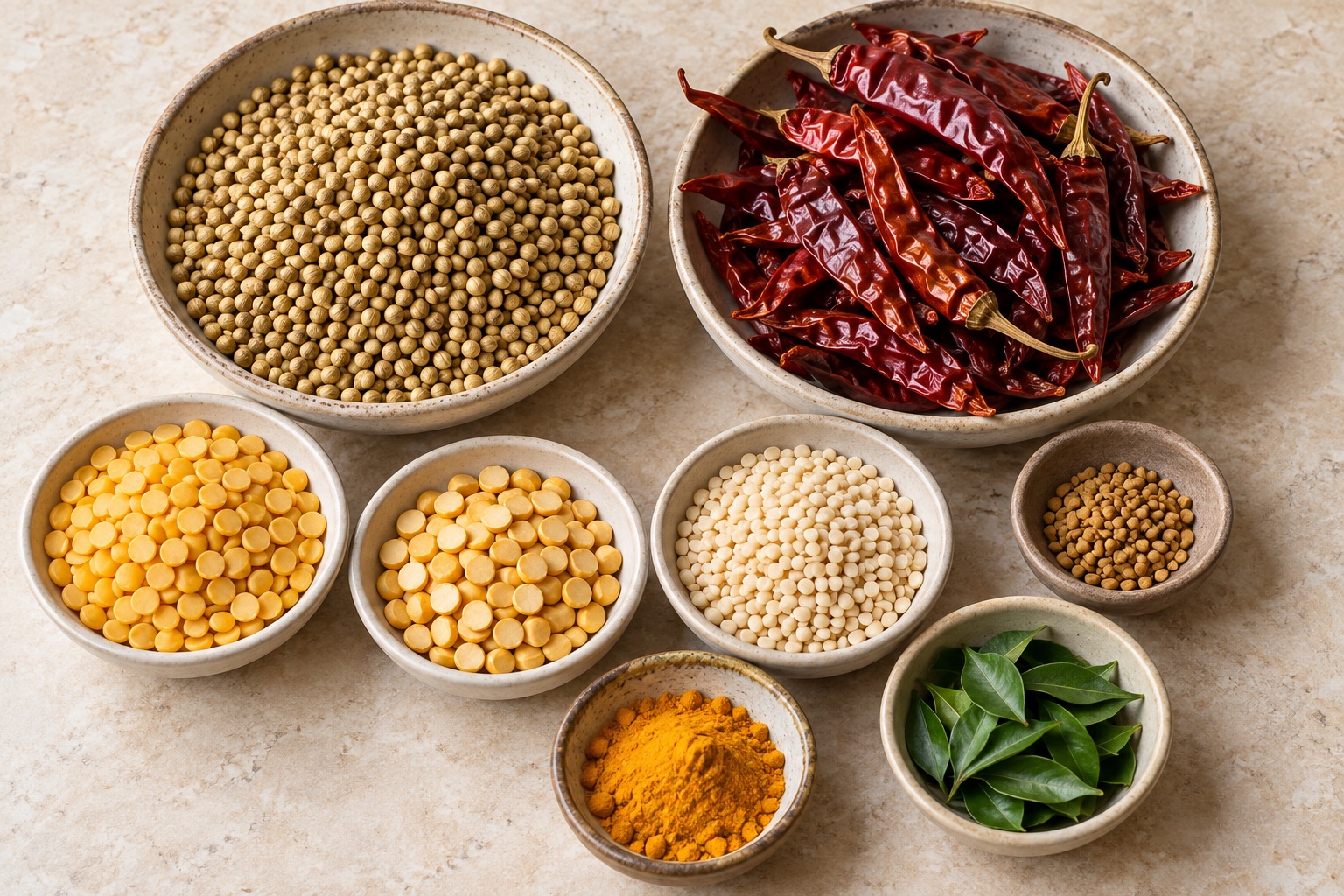
| Source | Coriander seed | Dried red chilli | Toor dal | Chana dal | Urad dal | Fenugreek |
|---|---|---|---|---|---|---|
| Gulf News, bulk batch [1] | 450 g | 450 g | 50 g | 50 g | 25 g | 25 g |
| Onmanorama, Tamil-style [2] | 50 g | 50 g | 2 tbsp | 2 tbsp | 2 tbsp | 2 tbsp |
| Sandhya Hariharan, Palakkad kitchen [3] | 1 cup | 1 cup | 2 tsp | 2 tsp | 1/4 tsp | 1 tsp |
| IndianHealthyRecipes (Swasthi's) [4] | 1/4 cup | 8-12 whole | 1 tbsp | 1.5 tbsp | 1.5 tbsp | 3/4 tsp |
| Archana's Kitchen [5] | 3 cups | 1/4 cup (chilli powder) | 1 cup | 1/2 cup | 1/4 cup | 1/4 cup |
Two things stand out. First, coriander and chilli are almost always close to equal by weight - the Gulf News and Onmanorama recipes use exactly 1:1. Second, Archana's Kitchen is the outlier: it uses ready chilli powder instead of whole dried chillies and a much higher coriander-to-chilli ratio, which is a useful reminder that "sambar powder" covers a real range of recipes, not one formula everyone follows.
A starting ratio to try at home
Building on the pattern above, this is a reasonable starting point for a first batch - not a fixed recipe, just the median of what real households use:
- 1 cup coriander seeds
- 1 cup dried red chillies - start with 3/4 cup if you want it milder; chilli is the easiest lever to adjust
- 2 tbsp toor dal
- 2 tbsp chana dal
- 1 tbsp urad dal
- 1/2 tsp fenugreek seeds
- 1/2 tsp turmeric powder
- A small handful of dried curry leaves (optional)
Taste the batch after grinding a small test portion first. Chilli heat and coriander freshness both vary a lot between suppliers, so the same measured recipe can come out noticeably hotter or milder depending on what you started with.
Why does the ratio vary so much between kitchens?
Because there was never a single sambar powder recipe to begin with - only regional habits that got written down later. Palakkad-based food writer Sandhya Hariharan puts it plainly: "Every household and every region have their own version of this sambar podi - like Chettinad Sambar, Kerala Sambar" [3]. Swasthi Vijay, whose sambar powder recipe is one of the most widely followed online, makes the same point from the other direction, noting that ingredients like coconut, cinnamon and even stone flower (dagad phool) show up in some regional versions, and that her own family's temple-cook recipe used both spices - a combination she describes as simply "too strong" for everyday cooking [4].
In practice, the variation comes down to three things: how much chilli versus coriander a family likes, whether dal is added at all (some very old recipes skip it entirely), and whether the blend is roasted dry or ground fresh with a little oil or coconut.
Does Kerala sambar even use a stored sambar podi?
Often, no - and this is the detail most generic "sambar powder recipe" posts skip entirely. Kerala home cooking has a real tradition of grinding sambar spices fresh for each pot rather than keeping a jar of stored podi on the shelf. Food writer Ammini Ramachandran's Palakkad-rooted recipe, documented on Cooking and Me, states outright: "Amma never adds coconut to sambar" - and the spice base is ground fresh each time rather than pulled from a stored tin, with the option to substitute a stored powder only mentioned as a shortcut for busy days [6]. Northern Kerala kitchens go a different way again, sometimes grinding in roasted coconut for a variant that reads closer to Tamil Nadu's coconut-based arachuvitta ("ground") masala than to a dry stored powder [7].
Where a Kerala kitchen or shop does keep a stored, dry sambar powder, it tends to differ from the Tamil Nadu version in a specific way: more coriander relative to chilli, so the blend reads rounder and more aromatic rather than straightforwardly hot, often with curry leaf milled straight into it. Miller Stores' own Kerala-style Sambar Powder follows that pattern - coriander-led, with curry leaf and roasted dal in the mix, and deliberately less punishing on the chilli than a typical Tamil-style blend built to carry a heavier hand of tamarind.
How to make sambar powder at home
- Measure out the coriander, chilli, dals and fenugreek separately. Don't mix them before roasting.
- Dry-roast each ingredient on its own, on a low flame, stirring constantly. Coriander and the dals take the longest and need to turn a shade darker and smell toasted; fenugreek needs only a minute or so before it starts to turn bitter, so pull it early.
- Roasting everything together in one pan is the common shortcut, and it reliably either scorches the fenugreek or leaves the coriander under-roasted - roasting separately is more effort but is what keeps the balance right.
- Let every ingredient cool completely before grinding. Warm spices release moisture in a grinder and the powder clumps.
- Grind everything together once cool, along with the turmeric powder, until fine. The natural oils in the roasted dal help bind the powder rather than leaving it powdery and separate.
- Cool the ground powder fully before sealing it into a jar - sealing it warm traps moisture and shortens its shelf life.
How to store it, and how long it lasts
Keep sambar powder in an airtight, opaque container, somewhere cool and dark - light and heat are what fade a roasted spice blend fastest. A batch with roasted dal in it needs to stay especially dry, since moisture is what turns a sambar powder stale-smelling rather than just less fragrant. As a rough guide, a properly roasted, airtight batch holds its aroma for about three months; after that it's still safe to use, it just tastes flatter.
When should you just buy sambar powder ready-made?
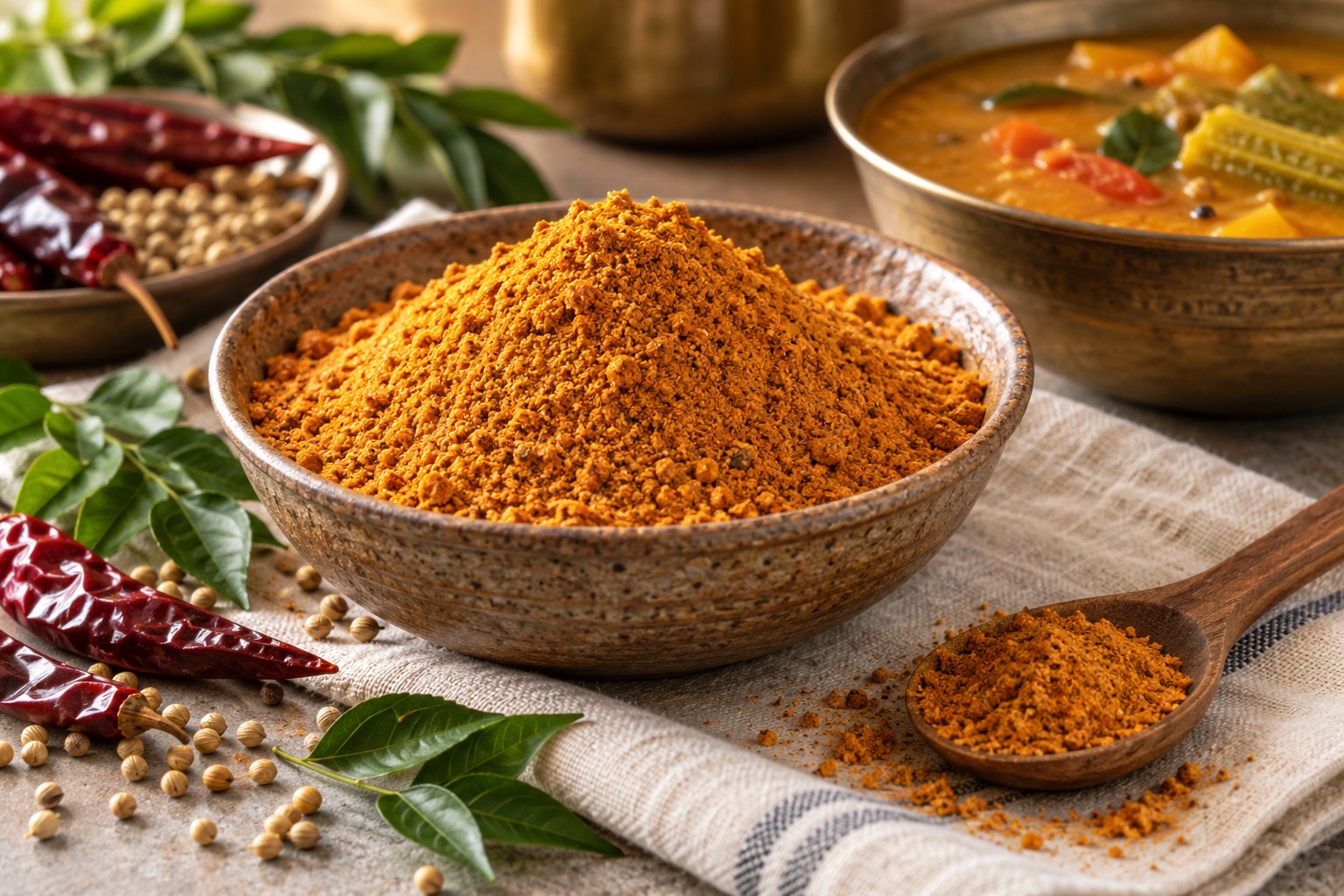
Buying it makes sense the moment the honest trade-offs stop mattering to you. Roasting six ingredients separately, cooling them, grinding and sealing a batch takes the better part of an hour for something you'll use two tablespoons of at a time - and if you don't have a spice grinder that can handle whole dal and dried chilli without overheating, home grinding is genuinely harder to get right than it looks in a recipe card.
What you lose by buying is control over the exact ratio and the freshest-possible roast. Miller Stores' Sambar Powder is milled to order at our Kondapur and Serilingampally stores in Hyderabad rather than produced in a long factory run and warehoused - coriander seed as the base, with dried red chilli, fenugreek, curry leaf and roasted dal, each roasted separately before milling, with no rice flour or starch bulking, no added colour and no preservative. The trade-off is the same one any small-batch blend has: it has a shorter useful shelf life than a mass-produced packet, because there's nothing added to extend it. If you're short on time on a weeknight rather than wanting to cook, our Instant Sambar Powder is the quicker option - a pre-mixed blend meant to go straight into the pot rather than one you'd season to taste.
If you'd rather buy the components separately and blend your own ratio at home, our Green Premium Coriander Powder and Guntur Chilli Powder are both milled fresh - though for the fullest aroma in a from-scratch batch, whole coriander seed roasted just before grinding still beats starting from powder, since ground spice loses aroma faster than the whole seed does.
What we've learned milling ours
Roasting each spice separately isn't optional if you want a clean result - coriander, chilli, fenugreek and dal all reach their roasting point at different times, and roasting them together is the shortcut that either scorches the fenugreek or under-roasts the coriander. Once everything is cool, milling it together in one pass lets the natural oils in the roasted dal bind the powder, which is also why a good sambar powder should never feel like loose, dry dust. We mill our Kerala-style blend to order in small batches rather than holding a large finished stock, for the same reason a three-month aroma window matters: a blend that sits warehoused for longer than that is already past its best by the time it reaches a shelf.
Limitations: what a ratio chart can't tell you
None of this is a regulated standard - there's no single body that defines "correct" sambar powder the way there is for, say, an ISO spice grade. The ratios above are a compiled pattern from published recipes and one commercial blend, not a scientific consensus, and chilli heat varies enough between batches and suppliers that the same measured recipe won't taste identical twice. If you're cooking for someone with a chilli sensitivity or a medical reason to watch spice intake, start well below any ratio here and adjust up, rather than trusting a fixed measurement.
Frequently asked questions
What is the basic ratio of chilli to coriander in sambar powder?
Most published recipes use close to equal parts by weight - roughly a 1:1 ratio of dried red chilli to coriander seed - then adjust the chilli up or down for heat. A few recipes lean much more coriander-heavy, so treat 1:1 as a starting point rather than a rule.
Is Kerala sambar powder different from Tamil sambar podi?
Often, yes. Many Kerala kitchens grind spices fresh for each pot instead of keeping a stored podi, and where a stored Kerala-style powder is sold, it tends to carry more coriander relative to chilli than a typical Tamil-style blend, which is usually built hotter to carry a heavier hand of tamarind.
Can I make sambar powder without dal?
Yes - some older, simpler recipes skip dal entirely and rely on coriander, chilli, fenugreek and turmeric alone. The dal mainly adds body and a slightly rounder mouthfeel to the cooked sambar; it doesn't change the heat or the core flavour much.
How long does homemade sambar powder last?
A properly roasted batch kept airtight, cool and dark holds its aroma for around three months. It's still safe to use after that, but the flavour fades noticeably, so make quantities you'll actually finish within that window.
Is bought sambar powder as good as homemade?
It depends what you're optimising for. Home-ground powder wins on freshness and lets you set your own chilli level; a small-batch milled powder like ours trades a little of that control for consistency and the time you'd otherwise spend roasting and grinding. A mass-produced supermarket tin trades further freshness for a much longer shelf life through added preservatives or a hotter industrial roast.
What's the difference between sambar powder and instant sambar powder?
Sambar powder is a roasted spice blend you season a pot of dal and vegetables with yourself. Instant sambar powder is a more complete pre-mixed blend meant to be added directly for a faster result, generally with less room to adjust the seasoning to taste.
Why does my homemade sambar powder taste bitter?
Over-roasted or over-measured fenugreek is the usual cause. Fenugreek turns bitter fast once it's roasted too long or too dark, and because it's used in a small quantity relative to everything else, it's easy to overdo without noticing until the batch is ground.
Sources
- Gulf News. Recipe for homemade sambar powder (2021). gulfnews.com
- Onmanorama. Make Tamil style sambar powder at home (2021). onmanorama.com
- Sandhya Hariharan. Sambar Powder Recipe | Sambar Podi, Palakkad Recipes. sandhyahariharan.co.uk
- Swasthi Vijay, IndianHealthyRecipes. Sambar Powder Recipe (Sambar Masala). indianhealthyrecipes.com
- Archana's Kitchen. Sambar Powder Podi Recipe. archanaskitchen.com
- Ammini Ramachandran, Cooking and Me. Kerala Vegetable Sambar Recipe. cookingandme.com
- Onmanorama. Arachuvitta sambar: Savour the flavours of Tamil Nadu (2024). onmanorama.com
Home cooking ratios vary by family and region; nothing above is a regulated or single "correct" standard. See also: Kashmiri vs Guntur vs Byadgi chilli, which to use when and how to spot adulterated chilli powder, turmeric and coriander at home.