The easiest ragi flour recipes for breakfast are ragi puttu, instant ragi dosa, ragi idli, ragi rotti and ragi porridge. Each takes 10 to 25 minutes once the flour is in the house. Ragi (finger millet) has no gluten, so most batters need a little rava, rice flour or curd to bind, and the doughs need hot water.
Key takeaways
- Ragi flour is finger millet (Eleusine coracana). India's food composition tables list 364 mg calcium, 4.62 mg iron and 11.18 g fibre per 100 g of the grain [1].
- Ragi has no gluten, so doughs crack unless you use hot water, and batters need rava, rice flour, curd or an idli batter base to hold together.
- Kerala-style puttu and idiyappam need the flour steamed or roasted first. Dosa, uttapam and pancakes don't.
- Start by swapping a quarter to half the rice or wheat in a recipe you already make. It is the easiest way to get the family used to the colour and taste.
What can I make with ragi flour for breakfast?
You can make almost any South Indian breakfast with ragi flour, either on its own or blended with rice flour or rava. ICAR's Indian Institute of Millets Research publishes a recipe book of millet dishes built on the same idea [2]. Here are ten that work on a weekday morning.
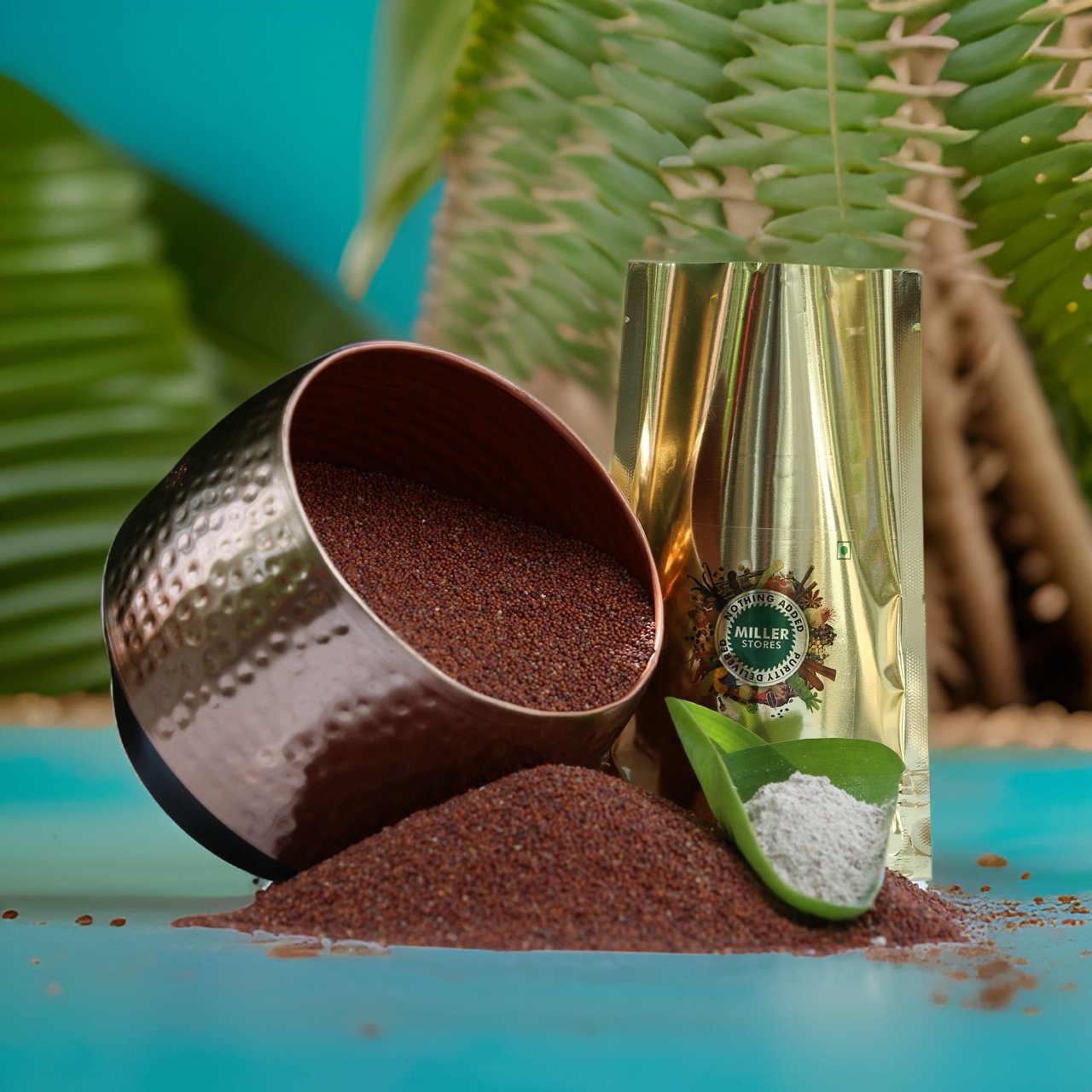
| # | Breakfast | Ragi share | Binder or partner | Active time |
|---|---|---|---|---|
| 1 | Ragi puttu | 100% | Grated coconut | 15 min |
| 2 | Instant ragi dosa | About 50% | Rice flour + rava + curd | 15 min |
| 3 | Ragi idli | About 30% | Regular idli batter | 10 min (batter ready) |
| 4 | Ragi rotti (Karnataka style) | 100% | Onion, chilli, coriander | 20 min |
| 5 | Ragi idiyappam | About 50% | Rice flour | 25 min |
| 6 | Ragi porridge (kanji or malt) | 100% | Milk or buttermilk | 10 min |
| 7 | Ragi kuzhi paniyaram | About 30% | Idli or dosa batter | 15 min |
| 8 | Ragi uttapam | About 50% | Dosa batter | 15 min |
| 9 | Ragi vegetable chilla | About 60% | Besan | 15 min |
| 10 | Ragi banana pancakes | About 50% | Banana + wheat flour + milk | 15 min |
How do you make ragi puttu?
Ragi puttu is ragi flour dampened with salted water, then steamed in layers with coconut. It is the Kerala breakfast most people try first.
- Dry-roast 1 cup of ragi flour on low heat for 3 to 4 minutes, until it smells toasty. Cool it.
- Sprinkle in salted water a tablespoon at a time, rubbing it in with your fingers, until the flour looks like wet sand and holds its shape when pressed. It should not form a dough.
- Rest the flour for 10 minutes, then pulse it in a mixer for a few seconds to break up lumps.
- Layer the puttu maker: 2 tablespoons of grated coconut, then ragi, then coconut, until full.
- Steam for 6 to 8 minutes, until steam comes out of the top. Serve with banana and sugar, or with kadala curry.
How do you make instant ragi dosa?
Instant ragi dosa needs no grinding or fermenting, just a thin batter of ragi, rice flour and rava rested for 15 minutes.
- Whisk 1/2 cup ragi flour, 1/4 cup rice flour, 1/4 cup fine rava, 1/4 cup curd and salt with about 1 1/2 cups of water. The batter should be as thin as buttermilk.
- Stir in a chopped onion, a green chilli, curry leaves and 1/2 teaspoon of cumin. Rest for 15 minutes.
- Heat a tawa until very hot. Pour the batter from the edges inwards, rava-dosa style. Don't spread it.
- Drizzle oil and cook on medium heat for 2 to 3 minutes, until crisp. There is no need to flip.
How do you make the other eight?
3. Ragi idli
Stir 1 cup of ragi flour into 3 cups of fermented idli batter with a little water. Steam for 10 to 12 minutes. The idlis come out brown and soft.
4. Ragi rotti
Mix ragi flour with chopped onion, green chilli, coriander and salt, then knead it with hot water into a soft dough. Pat it thin on a greased tawa with wet fingers and cook it covered until the edges lift.
5. Ragi idiyappam
Steam or roast a 1:1 mix of ragi and rice flour, then knead it with boiling salted water. Press it through the idiyappam mould onto idli plates and steam for 8 to 10 minutes.
6. Ragi porridge
Whisk 2 tablespoons of ragi flour into 1/2 cup of cold water so it doesn't lump. Add 1 cup of water or milk and cook, stirring, for 5 to 7 minutes. Sweeten it with jaggery, or cool it and stir in salted buttermilk.
7. Ragi kuzhi paniyaram
Add ragi flour, onion, grated carrot and curry leaves to leftover idli batter. Cook it in a greased paniyaram pan, turning once.
8. Ragi uttapam
Thicken dosa batter with ragi flour. Spread it thick on the tawa and top with onion, tomato and coriander. Cover and cook on low heat.
9. Ragi vegetable chilla
Mix ragi flour and besan roughly 3:2 with grated vegetables, turmeric and water into a pourable batter. Cook thin chillas on both sides.
10. Ragi banana pancakes
Mash a ripe banana and whisk in ragi flour, wheat flour, milk and a pinch of baking powder. Cook small pancakes on a buttered pan.
What goes wrong with ragi flour, and how do you fix it?
- The dough cracks: ragi has no gluten. Use very hot water and knead while it is warm.
- The dosa sticks or tears: the tawa isn't hot enough, or there isn't enough rice flour or rava. Add 2 tablespoons more.
- It tastes bitter or earthy: dry-roast the flour for a few minutes first, or pair it with coconut, jaggery or onion.
- The flour smells stale: ragi flour keeps best in an airtight jar away from heat. Buy smaller packs and use them within weeks, not months.
Is ragi flour right for everyone?
Ragi is naturally gluten-free, but a flour can pick up wheat in a shared mill, so people with coeliac disease should check how it was processed. Ragi's calcium figure comes from the raw grain [1]. How much the body actually absorbs depends on the rest of the meal, so treat ragi as part of a varied diet, not a supplement.
Where to buy ragi flour
Every recipe above works with our Ragi Flour. For a no-grind millet batter, try our Millet Dosa Mix. For something sweet with your porridge, read jaggery vs palm sugar vs coconut sugar.
Frequently asked questions
Is ragi flour good for breakfast every day?
Ragi can be part of a daily breakfast, as it adds fibre, calcium and iron [1]. Rotate it with other grains and pulses so the diet stays varied. Most families alternate ragi dosa, puttu and porridge through the week rather than eating the same dish daily.
Does ragi dosa need fermentation?
No. Instant ragi dosa uses rice flour, rava and curd and only needs a 15-minute rest. If you want a fermented, softer dosa, stir ragi flour into regular fermented dosa batter instead, roughly 1 cup of ragi to 3 cups of batter.
Why does my ragi puttu turn out hard?
There is either too much water or not enough steaming. The flour should feel like damp sand, not dough. Pulse it in a mixer to break up lumps, and steam until steam comes out of the top of the puttu maker, usually 6 to 8 minutes.
Can babies and children eat ragi?
Ragi porridge is a traditional first food in many South Indian homes. Ask your paediatrician when to introduce it and how to prepare it for your child's age, especially about texture and portion size.
How much calcium is in ragi?
The Indian Food Composition Tables 2017 list 364 mg of calcium per 100 g of ragi grain [1], far more than rice or wheat. The amount the body absorbs from a cooked dish is lower and depends on the rest of the meal.
Last updated 30 September 2026.
Sources
- ICMR-National Institute of Nutrition. Indian Food Composition Tables 2017 (ragi, food code A010). nin.res.in
- ICAR-Indian Institute of Millets Research. Millet Recipes: A Healthy Choice. millets.res.in
This article is general food information, not medical advice.