Pick jaggery powder for payasam, chikki and everyday Indian sweets, palm jaggery for karupatti coffee and Tamil and Kerala desserts, and coconut sugar when you want a mild caramel taste that won't take over the dish. All three are mostly sugar. Swap them for flavour, not for health, and count them as added sugar either way.
Key takeaways
- Cane jaggery is made by boiling sugarcane juice [1]. Palm jaggery comes from palmyra sap (neera) [2]. Coconut sugar comes from the sap of coconut flower buds [3].
- All three are mostly sucrose. FSSAI's standard requires cane jaggery to be at least 70% sucrose and 90% total sugars [1], and palmyra jaggery tested at about 91% carbohydrate [2].
- Coconut sugar's widely quoted glycaemic index of 35 comes from one Philippine test [3]. A later controlled study found no significant difference between coconut sap jaggery and cane sugar [4].
- WHO counts sugars added by the cook as free sugars and advises keeping them below 10% of daily energy [5]. That limit covers all three.
- The real differences are flavour, colour, moisture and how each behaves in cooking.
What is the difference between jaggery, palm sugar and coconut sugar?
They differ in the plant the sap comes from, which shapes their flavour, colour and moisture.
| Point | Jaggery powder (cane) | Palm jaggery (karupatti) | Coconut sugar |
|---|---|---|---|
| Source | Sugarcane juice [1] | Palmyra palm sap, neera [2] | Coconut flower-bud sap [3] |
| How it's made | Juice boiled down and set or powdered | Neera boiled down and set in moulds | Sap boiled down and granulated |
| Flavour | Deep molasses, slightly salty | Smoky, mineral, less sweet | Mild caramel, butterscotch |
| Colour | Golden to dark brown | Dark brown to black-brown | Light to medium brown |
| Best for | Payasam, chikki, laddoo, unniyappam, chutneys | Karupatti coffee, panakam, kozhukattai | Baking, tea, coffee, cereal toppings |
| Dissolves | Fast (powder) | Slower; grate it first | Fast |
| Swap for 1 tsp sugar | About 1 tsp, adjusted to taste | A heaped tsp, as it tastes less sweet | About 1 tsp |
Which is healthier: jaggery, palm sugar or coconut sugar?

None of them is a health food. They carry slightly more minerals than white sugar, but they are all mostly sugar, and you eat far too little of any of them for the minerals to matter - including our own Coconut Sugar (Natural).
- Cane jaggery: FSSAI's standard requires at least 70% sucrose and 90% total sugars [1].
- Palm jaggery: a process study of palmyra jaggery measured about 91% carbohydrate at 8.5% moisture [2].
- Coconut sugar: the Philippine Food and Nutrition Research Institute reported a glycaemic index of 35 [3]. But a controlled study comparing coconut sap jaggery with cane sugar found no significant difference in blood-glucose response: GI 65 against 61, both moderate [4].
WHO's advice is to keep free sugars, which include any sugar you add while cooking, below 10% of daily energy, and ideally below 5% [5]. Choosing jaggery over sugar does not change that limit.
How do you choose the right sweetener for a dish?
- Match the tradition. Kerala payasam and unniyappam were built on cane jaggery. Tamil karupatti coffee and some temple sweets use palm jaggery. The dish tastes right with the sweetener it grew up with.
- Mind the colour. Dark palm jaggery turns a milk payasam brown. Coconut sugar keeps it lighter.
- Mind the milk. Add jaggery to milk only after taking it off the heat, or dissolve it separately and cool it, as hot jaggery can curdle milk.
- Grate or powder solid blocks before measuring, as they dissolve unevenly.
- Taste as you go. Sweetness varies by batch, so start with less than the recipe says.
How do you store jaggery, palm sugar and coconut sugar?
- Keep all three in airtight jars, away from the stove and sink. They absorb moisture from the air and go sticky or lumpy.
- In Kerala's monsoon, store only small amounts in the kitchen and keep the rest sealed.
- If jaggery powder clumps, break it up with a dry spoon or pulse it briefly in a dry mixer.
Which ones do we stock?
We currently stock coconut sugar. Palm jaggery is on our list to bring back into stock.
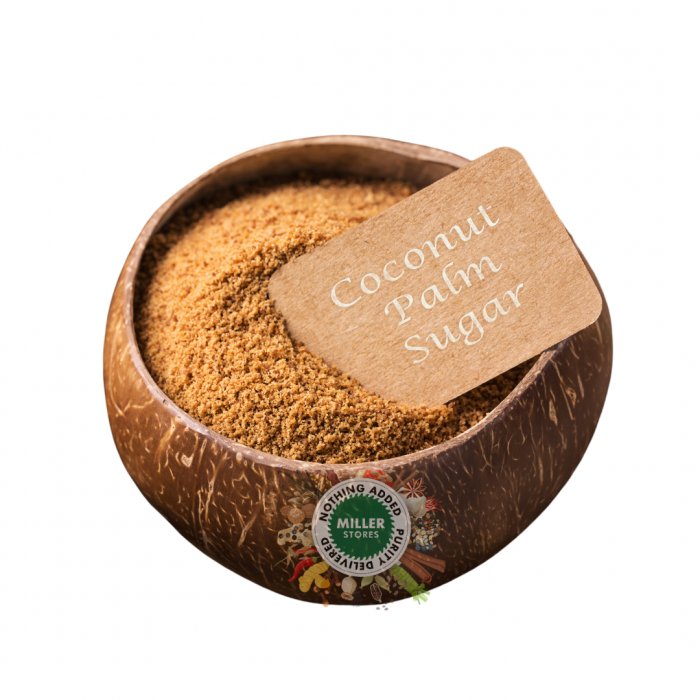
Where to buy jaggery, palm and coconut sugar
Shop our Coconut Sugar (Natural). For palm jaggery and cane jaggery, see our natural sweeteners range. For a breakfast to use them in, try the ragi porridge in 10 breakfasts with ragi flour.
Frequently asked questions
Is palm sugar the same as coconut sugar?
Not quite. In India, "palm sugar" usually means palm jaggery or palm candy made from palmyra palm sap. Coconut sugar comes from the sap of coconut flower buds. Both are palm saps, but they come from different trees and taste different: palmyra is smoky and coconut is caramel-like [2][3].
Is jaggery better than sugar for diabetics?
Not in any way that matters for blood sugar. Cane jaggery is at least 70% sucrose by FSSAI's standard [1], and it raises blood glucose much as sugar does. People with diabetes should count jaggery as sugar and follow their doctor's or dietitian's advice.
Does coconut sugar really have a low glycaemic index?
One Philippine test reported a GI of 35 [3], but a controlled study found coconut sap jaggery raised blood glucose about as much as cane sugar [4]. Treat the low-GI claim with caution and use coconut sugar for its flavour.
Can I use jaggery powder in tea and coffee?
Yes, but stir it in after the tea or coffee is off the boil. In milky tea, very hot jaggery can split the milk. Karupatti (palm jaggery) coffee is a Tamil tradition made the same way.
Why does jaggery powder become hard or sticky?
It absorbs moisture from the air. Keep it in a tightly closed jar away from steam, and use a dry spoon. If it clumps, break it up or pulse it in a dry mixer.
Last updated 30 September 2026.
Sources
- FSSAI. Standards of Cane Jaggery or Cane Gur (clause 2.8.4(2), Food Products Standards and Food Additives Regulations). fssai.gov.in
- Optimization of process parameters for production of palmyrah palm jaggery. Journal of Agricultural Engineering (ISAE). pub.isae.in
- International Coconut Community. Coconut sugar. coconutcommunity.org
- Glycemic responses by coconut (Cocos nucifera) jaggery and cane sugar (Saccharum officinarum): a comparative study. Asian Food Science Journal, 2021. doi.org
- World Health Organization. Guideline: sugars intake for adults and children. 2015. who.int
This article is general food information, not medical advice.