Kachi ghani is not a separate grade above cold-pressed - under Indian food law they are the same thing. FSSAI allows the "Kachi Ghani" or "Cold Pressed" label on mustard oil only when natural allyl isothiocyanate content is at least 0.20% by weight. "Wood-pressed" has no such test and no legal definition - it only names the equipment used.
By The MILLERS · Published 30 September 2026 · Last updated 30 September 2026
Quick answer: the three terms in one table
Before the detail, here is how the three terms actually differ - and which ones food law in India recognises with an enforceable test.
| Term | What it describes | Heat / solvent | Recognised by FSSAI? |
|---|---|---|---|
| Cold-pressed | Oil expressed mechanically, without adding external heat during pressing | No solvent. Friction can still raise the seed's temperature during pressing. | Yes, for mustard oil - as an alternate name for "Kachi Ghani," tested by allyl isothiocyanate content |
| Kachi Ghani | The traditional name for the same cold-press process, historically done in a wooden or stone "ghani" | No solvent | Yes, for mustard oil only - same 0.20% allyl isothiocyanate test as "Cold Pressed" |
| Wood-pressed | A marketing/process description: the press body is wood rather than a steel expeller screw | No solvent (in practice, almost always a cold press) | No. Not defined or tested anywhere in FSSAI's oils and fats standards |
| Refined | Oil that has been deacidified, degummed, bleached and deodorised after expression or solvent extraction | May use food-grade solvent for extraction; always uses heat (steam deodorisation) and processing aids | Yes - "Refined Vegetable Oil" is its own defined category with its own limits |
What does FSSAI actually mean by "Kachi Ghani"?
FSSAI's Food Product Standards regulations set a chemical standard for mustard oil (rapeseed oil/sarson ka tel), covering things like refractive index, iodine value and a mandatory negative test for argemone oil. Tucked into that standard is the one line that actually defines the term people argue about online: the oil "may be labelled as Kachi Ghani or Cold Pressed if the content of natural allyl isothiocyanate in the oil is not less than 0.20% by weight" [1].
Allyl isothiocyanate is the pungent compound that gives raw mustard oil its sharp smell and eye-watering bite. Heat and solvent processing drive it off, so a high reading is a reasonable proxy for "this oil was pressed cold and left largely untouched afterwards." That single number, not the type of press used, is what the regulation actually checks.
Two things follow directly from that wording. First, the standard uses "Kachi Ghani" and "Cold Pressed" as alternatives to each other - "or," not "and then a stricter tier called." Second, this specific, testable rule exists only for mustard oil. Groundnut, sesame, sunflower and coconut oil each have their own FSSAI standards, but none of them carry an equivalent named "cold-pressed" test with a chemical marker attached. For those oils, "cold-pressed" is an extraction-method claim the seller makes, not a number a lab can check against a named FSSAI clause.
So is kachi ghani the same as cold-pressed?
For mustard oil specifically: yes, legally. They are two names for one product, verified by one test. There is no FSSAI category that sits "above" cold-pressed and below some imagined pure kachi ghani grade - if a mustard oil qualifies for one label, it qualifies for both.
Where confusion creeps in is etymology, not regulation. "Ghani" is the name of the traditional press - originally an animal- or hand-turned stone or wooden mortar - and "kachi" is Hindi for raw or unrefined. So kachi ghani literally means "oil from the raw/unrefined press," describing how mustard oil was made in India long before steel expellers existed. Cold-pressed is simply the English, process-based description of the same idea, later formalised by FSSAI as an equivalent label. Neither word tells you which material the press was made of.
Then what does "wood-pressed" actually tell you?
Nothing that a lab can verify against a government standard - which is the honest answer, not a dismissal. Reading through FSSAI's entire oils and fats chapter (Chapter 2.2 of the Food Product Standards regulations), the word "wood" never appears as a category, a test or a labelling condition, for any oil [1]. "Wood-pressed" is a real, meaningful description of the equipment - a wooden ghani generates less friction heat than a steel expeller, so it plausibly presses closer to room temperature - but nobody is required to test or prove that claim before printing it on a label, the way a mustard oil seller is required to hit 0.20% allyl isothiocyanate before writing "Kachi Ghani."
In practice, that means "wood-pressed" and "cold-pressed" oils are very often the same oil described two different ways by two different sellers. The word to trust is whichever one comes with a number you can check, not the one that sounds more traditional.
Why does refined oil have a higher smoke point?
FSSAI defines Refined Vegetable Oil as any vegetable oil "obtained by expression or solvent extraction... deacidified with alkali and/or physical refining and/or by miscella refining using permitted food grade solvents and/or degumming... followed by bleaching with adsorbent earth and/or activated carbon and deodourised with steam," with no other chemical agent permitted [1]. That multi-step process strips out free fatty acids, colour compounds and the sharper-tasting volatile compounds that raw pressed oil keeps.
Free fatty acid content is also the main chemical reason smoke point changes. A 2025 peer-reviewed study on virgin olive oil found free fatty acid level had "the highest regression coefficient" of any factor tested and was "negatively related to the smoke point" - in other words, more free fatty acid means the oil smokes at a lower temperature. The same paper notes that "the oil refining process markedly reduces FFAs and other volatile compounds, resulting in refined edible oils having higher and more consistent smoke points than virgin oils" [2]. That chemistry isn't unique to olive oil - it's why an unrefined, cold-pressed groundnut or sesame oil will generally smoke sooner than its refined counterpart, and why the exact smoke point of a cold-pressed batch can shift a little from one pressing to the next depending on the seed and how the oil was stored.
Refining trades some of that raw character away, but it isn't free of its own cost. A 2020 peer-reviewed study tracking tocopherol (the vitamin E family of compounds) through four stages of oil refining found losses compounded at every stage, with the single steepest drop - reaching a cumulative 20.8% - at deodorisation, the final high-heat, high-vacuum step used to strip out odour and taste compounds [3]. Deodorisation is a required step in FSSAI's own definition of refined oil, so some tocopherol loss is a structural feature of refining, not a one-off manufacturing flaw.
Solvent, hexane and what the label doesn't say
FSSAI's mustard oil standard also spells out what happens when solvent is involved. If the oil is extracted with a solvent, it must be refined before sale, and the refined oil "shall not contain hexane more than 5.0 ppm." Oil made by the "expelled pressed method" - a mechanical press, cold or otherwise - carries a stricter line: it "shall be free from hexane residues" altogether [1]. In plain terms, a genuinely pressed oil should have no solvent trace to test for in the first place, because no solvent touched it; a solvent-extracted oil is allowed a small permitted residue after refining, not zero.
Refined oil sold in India also has to meet limits that pressed oil isn't tested against at all - moisture not exceeding 0.10% by weight, and trans fatty acid capped at 2% by weight (from 1 January 2022) [1]. None of this makes refined oil unsafe; it means refined and pressed oils are checked against two different rulebooks, and a "cold-pressed" claim isn't a shortcut past either one.
What the label can't prove on its own
A few honest limits, because a bottle's front label is marketing copy, not a certificate:
- "Cold-pressed" doesn't mean zero heat. Even FSSAI's own Virgin Coconut Oil standard defines the oil as expressed "by mechanical or natural means with or without the application of heat" [1] - so "cold" is a relative description of the process, not a guarantee that the seed never warmed up.
- A front label can't prove the allyl isothiocyanate number. Only a lab test against the FSSAI standard can confirm a mustard oil actually clears 0.20% - the words "Kachi Ghani" printed on a bottle are the seller's claim, not the test result itself.
- Wood-pressed has no number to check at all. Treat it as a process description you're trusting the seller on, not a verified category.
- None of this is a health test. These standards cover identity, purity and labelling, not a clinical claim about which oil is "better for you" - that's a separate, individual dietary question outside what a lab report like this can answer.
How we press ours
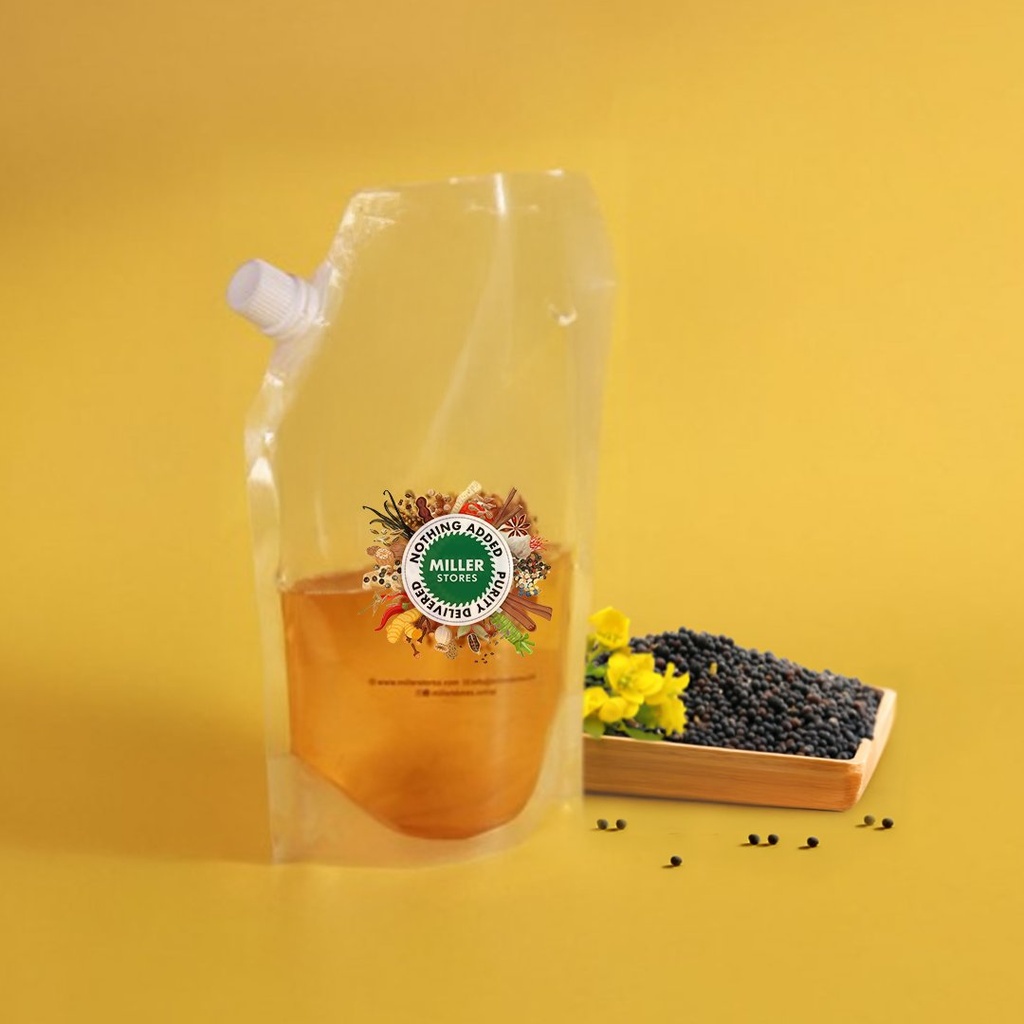
Our own Cold Pressed Mustard Oil (Kachi Ghani) is one ingredient: whole mustard seed, cleaned and crushed in a slow press, with no roasting and no added heat - which is exactly what "raw grinding" (kachi ghani) means. After pressing, the oil is rested and cloth-filtered rather than bleached or deodorised, so the dark amber colour and the allyl isothiocyanate that the FSSAI test looks for both stay in the bottle. There is no refined oil blended in.
The other adulterant worth naming here is argemone - the seed of the Mexican poppy, which resembles mustard seed closely enough to be used as a cheap bulking agent in the past, and is toxic. We test random batches for it and publish the reports rather than asking anyone to take that on trust.
| Language | Name |
|---|---|
| Hindi | Sarson ka tel |
| Tamil | Kadugu ennai |
| Telugu | Aavalu nune |
| Malayalam | Kaduku enna |
| Kannada | Sasive enne |
A quick way to check a bottle you already own
- Read the label for the FSSAI licence number and the actual product name (Rapeseed/Mustard oil, Kachi Ghani or Cold Pressed) rather than just a brand story.
- Smell and taste a few drops raw. Genuine unrefined mustard oil is sharp and slightly bitter/pungent; a mild, flat smell suggests refining or blending.
- Check the price against the category. Whole-seed, small-batch pressing yields less oil per kilogram of seed than solvent extraction, so a genuinely pressed oil rarely undercuts refined oil by a wide margin.
- If you need certainty rather than a reasonable guess, ask the seller for a batch lab report against the FSSAI mustard oil standard - our own lab reports page shows the kind of documentation to expect.
Buying cold-pressed oil
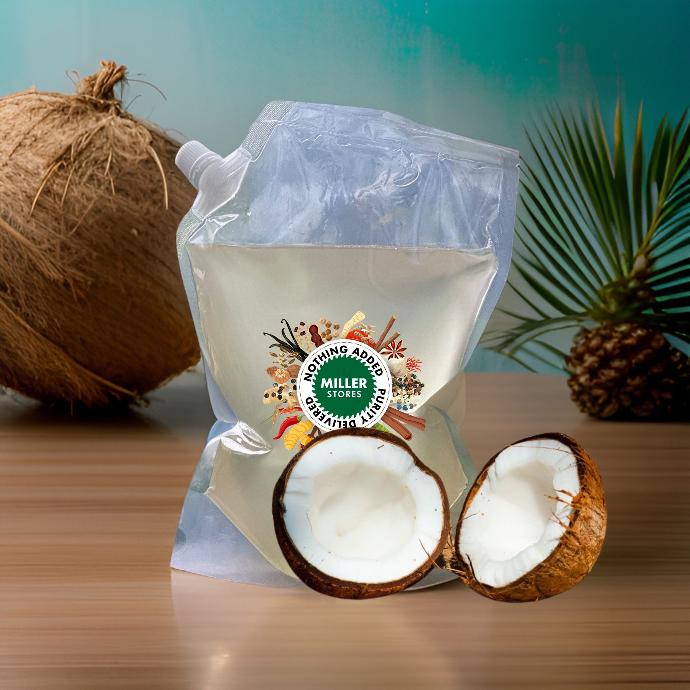
All of our unrefined, cold-pressed oils - mustard, groundnut, sesame, coconut, virgin coconut, flaxseed and almond - are listed together in our Freshly Extracted Oil category, pressed and sold without solvent or chemical refining. If mustard oil specifically is what brought you here, our Cold Pressed Mustard Oil (Kachi Ghani) is the one that carries the allyl isothiocyanate claim this article is about.
If you're also checking spices for purity rather than oil, our guide to spotting adulterated chilli powder, turmeric and coriander at home covers the same "claim vs. testable proof" idea for spices.
Frequently asked questions
Is kachi ghani mustard oil the same as cold-pressed mustard oil?
Yes, for mustard oil specifically. FSSAI treats "Kachi Ghani" and "Cold Pressed" as interchangeable labels for the same product, both cleared by one test: natural allyl isothiocyanate content of at least 0.20% by weight. Neither term is a stricter grade above the other.
What does "wood-pressed" mean, and is it FSSAI-regulated?
It describes an oil pressed using a traditional wooden ghani rather than a steel expeller. It is not defined, tested or regulated anywhere in FSSAI's oils and fats standards, so it carries no chemical marker the way Kachi Ghani mustard oil does. Treat it as a process claim, not a certified category.
Does cold-pressed oil really have a lower smoke point than refined oil?
Generally yes. Refining removes free fatty acids and volatile compounds, and free fatty acid content has been shown to have a strong inverse relationship with smoke point, which is why refined oils tend to have higher and more consistent smoke points than unrefined, pressed oils.
Is kachi ghani oil healthier than refined oil?
FSSAI's standards regulate identity and purity, not health outcomes, so neither label is a medical claim. What's measurable is that refining strips out some tocopherols (vitamin E family compounds) at each processing stage, with the biggest single drop during deodorisation, while it also removes free fatty acids and raises the smoke point. Which trade-off suits you is a personal cooking and diet decision, not something a lab standard settles.
Can cold-pressed oil be diluted or mixed with refined oil without it showing on the label?
A front label can say anything; only a lab test against the FSSAI mustard oil standard - including the allyl isothiocyanate check - can confirm the oil in the bottle matches the claim on it. If you need certainty, ask for a batch lab report rather than relying on the label alone.
Does "cold-pressed" mean the seed was never heated at all?
Not necessarily. Even FSSAI's own Virgin Coconut Oil standard allows expression "with or without the application of heat." Cold-pressed describes a process that avoids adding external heat during pressing; it doesn't guarantee the seed stayed at room temperature, since pressing itself generates some friction heat.
Sources
- FSSAI. Food Safety and Standards (Food Products Standards and Food Additives) Regulations, 2011 - Chapter 2.2: Fats, Oils and Fat Emulsions (compiled edition, updated 05.10.2023). fssai.gov.in
- Deciphering the Complexity of Smoke Point in Virgin Olive Oils to Develop Simple Predictive Models. Foods, 2025. pmc.ncbi.nlm.nih.gov
- Assessing the Impact of Oil Types and Grades on Tocopherol and Tocotrienol Contents in Vegetable Oils with Chemometric Methods. Molecules, 2020. pmc.ncbi.nlm.nih.gov
This article explains what regulatory and marketing terms on an oil label mean and what they don't prove. It is not a lab test result for any specific bottle, and it is not medical or dietary advice.