Yes — ground spice loses aroma faster than whole spice, and grinding is when that loss starts. Cutting a spice open exposes far more surface to air, and the volatile oils inside begin evaporating and oxidising at once. Heat and colour survive much longer than smell, so a months-old packet can still look and taste "fine" while smelling of almost nothing.
- Volatile oils are what you smell — a small, separate group of compounds from the heat compounds (capsaicin in chilli, piperine in pepper), which is why an old spice can stay hot but go flat.
- Grinding itself generates heat. Ambient milling raises the temperature of the spice inside the grinder, and that heat drives off part of the volatile oil before the powder even reaches a jar.
- Published research on this varies by spice — losses of 14-37% have been measured across different spices purely from grinding heat, and cryogenically-ground (cold-ground) pepper and coriander have both been measured to retain more oil than ambient-ground.
- There's no one honest "X% in Y days" number that applies to every spice — it depends on the spice, the particle size, and how it's stored afterward. Anyone who gives you one flat figure for "all spices" is guessing.
- Milled-to-order sidesteps the biggest variable, which isn't the mill — it's the months a packet sits on a shelf between being ground and being opened in your kitchen.
What you're actually smelling: volatile oils, not "freshness" in general
The smell that hits you when you open a fresh packet of ground pepper or chilli comes from volatile oils — small, light molecules (terpenes, aldehydes and similar compounds) that evaporate easily at room temperature. "Volatile" is doing real chemistry work in that phrase: these are literally the compounds most willing to leave the solid spice and enter the air, which is the same property that lets your nose detect them.
This is a different set of chemicals from the ones responsible for heat and colour. Capsaicin (chilli's heat), piperine (pepper's heat) and the carotenoid pigments behind red and orange colour are much less volatile — they stay put in the powder for a long time. That's the mechanical reason an old spice jar can still taste hot and look vivid while smelling like almost nothing: the compounds that carry aroma are simply not the same compounds that carry heat or colour, and they don't degrade at the same rate.
Why grinding is the moment the loss begins
A whole peppercorn, chilli pod or coriander seed keeps its volatile oil sealed inside intact plant cells, with only the outer skin exposed to air. Grinding breaks that structure open. The interior surface area exposed to oxygen increases by orders of magnitude in a single pass through the mill, and two things start happening at once: the newly exposed oil begins evaporating (which is why fresh-ground spice smells so much stronger than the whole spice did a minute earlier), and it begins oxidising on contact with air — a slower chemical change that dulls the aroma further over time.
There's a second, less obvious mechanism: the grinding itself is not a cold process. Milling generates friction, and that friction raises the temperature of the spice while it's inside the grinder — a food-technology teaching module from India's e-PG Pathshala digital learning programme puts the range at roughly 42-95°C depending on the spice's own oil and moisture content. That heat spike, happening in the same moment the oil is newly exposed to air, is why the losses measured from grinding heat alone can be substantial: the same source reports losses of 37% for nutmeg, 14% for mace and 17% for cinnamon attributable to this effect, and a 32% drop in caraway seed's volatile oil when the grinding temperature was raised from 17°C to 45°C [3]. Those figures are specific to those spices and to heat generated during the grind itself — they are not a general "your spice loses X% a month" number, and we're not presenting them as one.
This is measurable directly by comparing grinding methods. A 2015 study in the Journal of Food Science and Technology measured essential oil content in coriander powder ground on ordinary pin and hammer mills against coriander ground cryogenically (chilled with liquid nitrogen to keep the grinding zone cold), and found the ambient-ground samples came out lower — the authors attributed this directly to "temperature rise in both the hammer and pin mill grinding methods at ambient conditions," which caused loss of the essential oil constituents that the cold-ground samples kept [2]. A similar 2021 study on black pepper in the International Journal of Seed Spices found oil, oleoresin and piperine were "significantly more retained" in cryogenically ground pepper, with oil content 1.2-1.6% higher than in pepper ground the ordinary way [1]. Neither study is about how long the spice was left on a shelf afterward — both are about what the act of grinding itself does, which is the more fundamental point: some of the loss happens before the jar is even sealed.
So — do ground spices lose flavour, and how fast?
Yes, and the honest answer is that the rate genuinely differs by spice, so a single number for "spices" as a category would be misleading. What the research agrees on, across every spice it has been measured for, is the direction and the mechanism: more exposed surface plus more time equals less volatile oil. Whole spices consistently outlast their ground form for aroma, because an intact peppercorn or dried pod isn't losing anything until you cut into it. A U.S. university extension service puts it plainly for home cooks: "once ground, spices tend to gradually lose their flavor over time. Freshly ground provides the most abundant flavor" — and specifically recommends grating nutmeg right before use "because the flavor can be lost rapidly" once it's been cut open [4].
What none of this means is that an older ground spice is unsafe. Going flat is a flavour problem, not a food-safety one — see the limitations section below.
| Signal | Freshly milled | Ground spice that's sat for months |
|---|---|---|
| Smell on opening the jar | Hits you immediately, without needing to inhale hard | Muted — you often have to bring the jar right up to your nose |
| Colour | Bright, matches the whole spice it came from | Often still looks fine — colour fades slower than aroma does |
| Heat or pungency (chilli, pepper) | Full | Present but blunter — capsaicin and piperine are far less volatile than the aroma compounds, so heat outlasts smell |
| Texture | Can clump slightly — that's the natural oil still present | Dry, flows freely — the oil that made it clump has evaporated |
| What it means for cooking | Use the amount the recipe says | Not unsafe — just flatter, so people tend to over-add without getting the aroma back |
How we mill differently
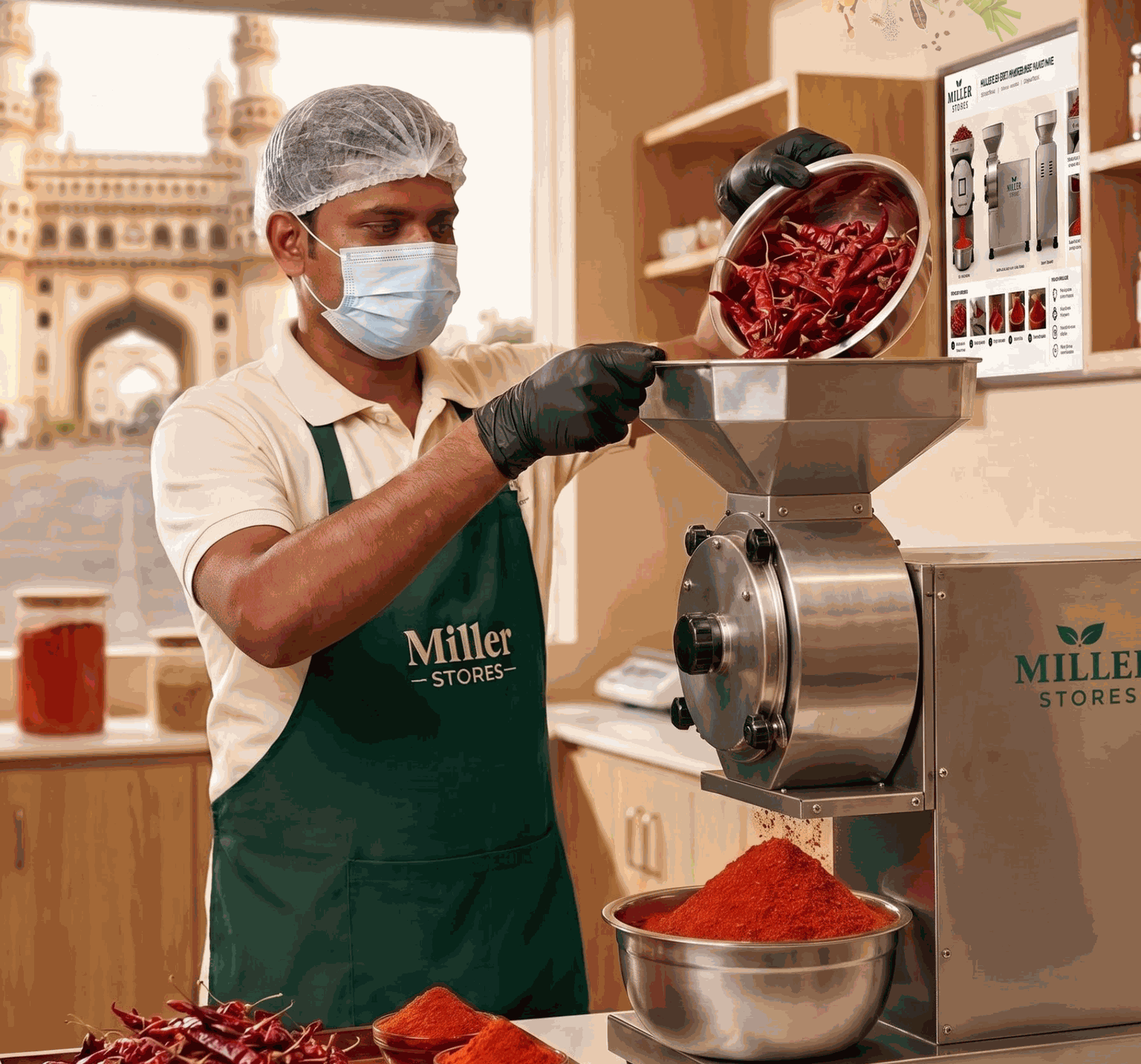
The mechanism above is exactly why our shops mill spice at the counter instead of selling packets ground months earlier. Whole pods and seeds are kept in the store; they're sorted, de-stemmed and milled only when a customer buys them or when an online order is packed. We don't hold ground stock — that's the reason the mill sits in the customer area rather than in a back room.

Take our Guntur Chilli Powder as an example: the product page describes whole pods from the Guntur belt being sorted, de-stemmed and milled at the counter, with the heat adjusted by how much seed and placenta goes into the grind. It's a useful illustration of the trade-off this article is about — that page's own storage advice says to use the powder within three to four months for full aroma, and puts it exactly the way the chemistry above predicts: "heat outlasts aroma — an old powder is not milder, it is flatter." That's the same capsaicin-versus-volatile-oil distinction covered in the section above, written from the counter rather than a lab.
How to keep more of the aroma once you're home
- Buy an amount you'll actually use in a few months, not a large bag to save a trip — the aroma clock starts the moment it's ground, whether you use it in a week or a year.
- Store it airtight. Every time a lid comes off, some volatile oil escapes with the air that rushes out and never comes back.
- Keep it opaque and out of light. Light accelerates the same oxidation that's already working on the exposed oil.
- Keep it cool, away from the stove. Since grinding heat alone measurably degrades oil in the studies above, ambient heat over months does the same thing more slowly — a cupboard beats a shelf above the hob.
- Judge freshness by smell, not colour. Rub a pinch between your fingers and smell it. If you have to work at it to notice anything, the volatile oils have thinned out, however good the colour still looks.
What "gone flat" does and doesn't tell you
It's worth being direct about the limits of everything above. A spice that's lost its aroma has lost flavour quality — it has not necessarily become unsafe, and smell is not a food-safety test. Rancidity, mould and contamination are separate problems with their own signs (off, sour or musty smells rather than simply faint ones; visible clumping, discolouration or mould; a taste that's actively unpleasant rather than just muted), and none of them are what this article is measuring. If a spice smells actively bad rather than simply faint, or shows visible mould or moisture damage, that's a spoilage question, not an aroma-fade one, and it should be discarded rather than judged by the tests above.
Where to buy freshly milled spice
Everything on this page is a reason to buy spice milled close to when you'll use it, rather than a packet that was ground on a factory floor some unknown number of months ago. Our Guntur Chilli Powder is milled to order from whole Sannam-type pods at our Hyderabad counters, or you can browse the rest of the Freshly Milled Spices range for turmeric, coriander, cinnamon and more, all ground only when ordered. If you're checking a powder for adulteration rather than just freshness, see our guide on spotting adulterated chilli, turmeric and coriander at home, or compare heat and colour across varieties in Kashmiri vs Guntur vs Byadgi chilli.
Frequently asked questions
Do ground spices lose flavour over time?
Yes. Grinding exposes the spice's interior to air, and the volatile oils that carry aroma evaporate and oxidise from that point on. Whole spices keep theirs sealed inside intact cells and last measurably longer before the same fading happens.
Why does a spice smell so much stronger right after it's ground?
Because grinding is the moment the volatile oils are first exposed to air. You're smelling the same oils that were sealed inside the whole spice a moment earlier — grinding doesn't create aroma, it releases what was already there, which is also why that same exposure is what lets it fade afterward.
If my spice still looks bright and tastes hot, is it still fresh?
Not necessarily. Colour (carotenoid pigments) and heat (capsaicin or piperine) are much less volatile than the aroma compounds, so they survive long after the smell has faded. Judge freshness by smell, not by how the powder looks or how hot it still tastes.
Does faded aroma mean the spice has gone bad or is unsafe to eat?
No — losing aroma is a flavour problem, not a safety one. Spoilage shows up differently: an off, sour or musty smell, visible mould, or damp clumping. A spice that's simply gone quiet in smell is fine to eat; it just won't taste like much.
Is cryogenically ground spice actually proven to retain more oil?
In the studies measured, yes, for the spices tested. Research on both coriander and black pepper found ambient (room-temperature) grinding measurably lower in essential oil or piperine than the same spice ground cryogenically, which the researchers attributed to the heat generated during ordinary grinding.
How long does freshly milled spice actually stay at its best?
It varies by spice, but a few months rather than a year is a reasonable rule of thumb for full aroma — our own Guntur Chilli Powder, for example, is best used within three to four months of milling. Buying a smaller amount more often keeps more of the gap between grinding and use.
Is it better to buy whole spice and grind it myself at home?
It closes the same gap milling-to-order does — the less time between grinding and using, the more volatile oil survives. The trade-off is a home grinder won't manage the fine, even powder a counter mill produces for something like chilli or turmeric.
Sources
- Balasubramanian, S., Roselin, P., Anand, T., Singh, U., Saxena, S.N., Singh, K.K. (2021). Physicochemical properties of ambient and cryoground black pepper. International Journal of Seed Spices, 11(1). epubs.icar.org.in
- Barnwal, P., Singh, K.K., Sharma, A., Choudhary, A.K., Saxena, S.N. (2015). Influence of pin and hammer mill on grinding characteristics, thermal and antioxidant properties of coriander powder. Journal of Food Science and Technology. link.springer.com (DOI: 10.1007/s13197-015-1975-0)
- e-PG Pathshala (National Mission on Education through ICT, Government of India). Grinding: Grinding Methods (Food Technology course module). ebooks.inflibnet.ac.in
- Norman-Burgdolf, H., Norris, A., Mullins, J. (2019). Savor the Flavor: Seasoning with Spices. University of Kentucky Cooperative Extension Service, FCS3-630. publications.ca.uky.edu
Loss percentages above are as reported by each source for the specific spice and condition studied (mainly heat generated during grinding itself) and should not be read as one universal rate for all spices or as a prediction of shelf-life loss over time. Ground spice going flat is a flavour change, not a food-safety signal — see "What 'gone flat' does and doesn't tell you" above.