Real saffron dissolves slowly in cold water, tinting it golden-yellow while the threads stay red; it smells hay-like, tastes gently bitter, and leaves no oily stain when pressed. Five simple checks — colour release, rub, aroma, thread shape and a paper-press test — screen for common fakes like dyed corn silk or safflower in minutes at home.
Written by The MILLERS team. Published 28 September 2026 · Last updated 30 September 2026.
These are FSSAI-listed or commonly used household screening checks, not a lab certificate. They catch crude, high-dose adulteration reliably; they cannot replace an ISO 3632 report if you need a certified grade. Details and sources for every claim below are listed at the end of this article.
Quick answer: the 5 tests (and what “real” saffron should do)
- Cold-water diffusion: Real saffron tints water a clear golden-yellow gradually; threads keep their red colour for several minutes.
- Rub or streak: A moistened thread rubbed on white paper or fingers leaves a yellow-orange stain, not a harsh red dye.
- Aroma and a tiny taste: Genuine saffron smells hay-like with honeyed notes (from safranal) and tastes slightly bitter — never sugary.
- Thread morphology: Stigmas look like trumpet-tipped, slightly frayed red threads; common fakes are tubular safflower florets or hair-like dyed corn silk.
- Paper/oil check: When pressed, pure dry saffron should not leave an oily stain; oiliness suggests tampering with oil, glycerin or syrup.

Before you start: what makes saffron “real”
Three natural compounds define authentic saffron quality: crocin (colour), picrocrocin (bitterness), and safranal (aroma) [3][4][5]. These are the same markers measured in laboratories under ISO 3632-1:2025, the current edition of the international saffron specification standard [1] — the benchmark to ask for when you want a certified grade or a lab report.
5 home tests to check if saffron is real
1) Cold-water diffusion test
- Place 5–7 threads in a clear glass of cold water (about 50–100 ml).
- Watch for 5–10 minutes without stirring.
- Check the water's colour and whether the threads themselves have faded.
- Real saffron: releases a transparent golden-yellow halo slowly; threads remain visibly red.
- Likely fake or dyed: water turns red or orange almost immediately; threads fade or leach heavy dye.
Why this works: crocin dissolves slowly in water, tinting it yellow without the threads instantly losing their own red colour. A sudden blood-red colour often indicates added dye rather than crocin [3][4].
2) Rub or streak test (paper/finger)
- Moisten one thread.
- Gently rub it between your fingertips, or streak it across a piece of white paper.
- Real: leaves a yellow to orange stain (from crocin) that builds gradually; the thread keeps its shape.
- Fake or dyed: produces a bright red smear immediately, or heavily stains skin or paper as a surface coating comes off.
This is close to the household method FSSAI describes for maize-cob-tendril fakes: genuine saffron keeps releasing colour gradually, while an artificially dyed tendril releases its colour rapidly and all at once [2].
3) Aroma (and a tiny taste) test
Warm a few threads in your palm for 10–15 seconds, then smell them. Authentic saffron has a complex hay-like, honeyed, slightly metallic aroma with a dry floral edge, thanks primarily to safranal. Nibble the tip of one thread: true saffron tastes gently bitter from picrocrocin; it should not be sweet [3][5]. If there is no aroma at all, the product may be old, spent, or not saffron.
4) Thread morphology under a bright light
Spread 10–15 threads on white paper and inspect them with a phone macro lens or a magnifying glass.
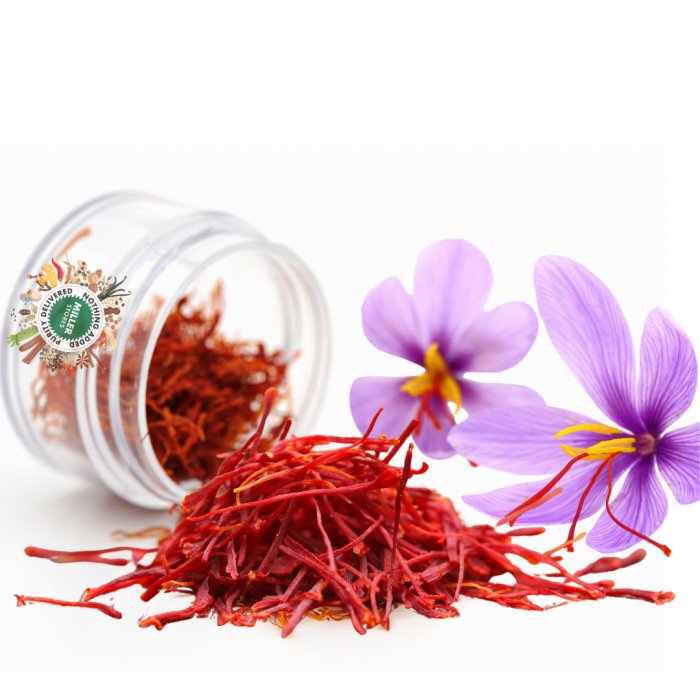
- Real stigmas: deep red, slightly rough, dense fibres with a gentle trumpet-like flare at one end; lengths vary and edges can look finely frayed.
- Common fakes:
- Safflower florets: a tubular, funnel-shaped corolla rather than a flared thread — dry, brittle, and a more uniform reddish-yellow than real stigmas, with no trumpet-shaped tip [6].
- Corn silk tendrils: hair-like, curly, translucent brown or yellow; easily confused with saffron once dyed.
Real saffron only ever comes as these flared, trumpet-tipped threads — never as a flat petal or a hair-like tendril. Our own Saffron Premium (whole threads) is sold exactly this way, as whole threads, so you can run this check against what actually arrives.
5) Paper/oil stain check
- Place a few dry threads between two pieces of white paper.
- Press firmly for 10–15 seconds.
- Pass: no oily halo on the paper; a faint yellow tint from crocin is normal.
- Fail: a visible oily stain or greasy feel — often a sign the threads were treated with oil, glycerin or syrup to add weight or shine, a practice reported in the peer-reviewed literature [3].
Real vs fake saffron: the 5 tests side by side
| Test | Real saffron | Likely fake or adulterated |
|---|---|---|
| Cold water, 5–10 min | Slow golden-yellow tint; threads stay red | Water turns red/orange almost at once; threads fade fast |
| Rub or streak on paper | Gradual yellow-orange stain | Immediate bright red smear |
| Aroma | Hay-like, honeyed, slightly metallic | Little or no smell, or a sweet/synthetic smell |
| Taste (tiny nibble) | Gently bitter | Sweet, syrupy or flavourless |
| Thread shape | Trumpet-flared tip, finely frayed edges | Tubular florets (safflower) or hair-like strands (corn silk) |
| Paper/oil press | No oily halo; faint yellow tint only | Visible oily or greasy stain |
What these five tests can, and can't, tell you
These are indicative, at-home screening checks, not laboratory proof. They reliably catch crude, high-dose adulteration: dyed corn silk, dyed safflower, or threads bulked with oil, glycerin or syrup [3][4]. They will not reliably catch a small percentage of adulterant blended into an otherwise-real batch, pesticide residue, heavy metals, or a synthetic dye chosen to mimic crocin's own colour. A negative result at home is reassuring; only a lab report is conclusive.
When home tests aren't enough: ISO 3632 and credible sellers
Home checks are good for screening, but only lab testing can certify quality and catch trace dyes. ISO 3632-1:2025 grades saffron by measured colouring strength (crocin), taste (picrocrocin) and aroma (safranal) [1]; the Codex Alimentarius standard for dried floral parts — saffron (CXS 351-2022) sets a parallel international benchmark [7]. Serious sellers should be able to share a recent lab result tied to your batch on request.
How we sell our saffron
Our Saffron Premium (whole threads) is sold as whole threads only — never as a pre-ground powder — which is also the form every test above is built for. We do not currently publish an ISO 3632 lab report for this product, unlike the chilli and turmeric batches on our lab reports page; if a certified grade matters for your order, ask us before you buy. Run the checks above on your own jar when it arrives — that is exactly what they are for.
Buying smart: a quick checklist
- Prefer whole threads over powders — powders are far easier to adulterate invisibly.
- Ask for a recent, verifiable ISO 3632 lab report tied to your specific batch if a certified grade matters to you.
- Choose airtight, opaque packaging with a harvest or pack date, and store it in a cool, dark cupboard rather than the fridge.
- Test a small sample at home using the checks above before using it in a recipe.
Ready to cook with the real thing? Explore our Saffron Premium (whole threads), browse other spices, and see how we approach transparency on our lab reports page.
Related reading
Checking your spice rack for adulteration doesn't stop at saffron. See how to spot adulterated chilli powder, turmeric and coriander at home, and if you're choosing between chilli grades, Kashmiri vs Guntur vs Byadgi chilli: which to use when.
FAQ: real vs fake saffron
Does real saffron colour milk or water?
Yes, but gradually. Genuine threads release a clear golden-yellow tint over five to ten minutes in cold water, and the threads themselves stay red rather than bleaching out immediately. If the water turns red or orange within seconds, or the colour looks artificial, that is a sign of added dye rather than crocin.
Should saffron taste sweet?
No. A sweet or syrupy taste usually means sugar, honey or glycerin has been added to bulk up the weight — a documented adulteration method in the scientific literature. Genuine saffron tastes gently bitter, from a compound called picrocrocin, alongside its hay-like aroma. Sweetness on the tongue is one of the clearest home-test red flags.
Does Kashmiri or another named origin prove saffron is real?
No. Origin labels are easy to misuse and hard for a shopper to verify from packaging alone. A name like “Kashmiri” does not replace the water, rub, aroma, thread-shape and paper-press checks above — or, for certainty, an ISO 3632 lab report tied to that specific batch.
How should saffron threads be stored to stay fresh?
Keep threads in an airtight, opaque container away from direct light, heat and moisture — a cool cupboard rather than the fridge, since moving a cold jar in and out of a warm kitchen causes condensation. Whole threads hold their aroma and colour far longer than a ground powder would, because they haven't yet been opened up to air.
What does an ISO 3632 grade or lab report actually measure?
ISO 3632-1:2025 grades saffron by three lab measurements: crocin (colouring strength), picrocrocin (bitterness) and safranal (aroma), checked by spectrophotometer rather than by eye. A report tied to your specific batch is the only way to confirm grade and catch trace dyes that home tests can miss. We do not currently publish one for our saffron.
Can the iodine test be used on whole saffron threads?
Not usefully — it is a powder-only check. A drop of pharmacy iodine turns deep blue in the presence of starch, which is how starch fillers in ground saffron are caught; whole threads have no powder surface for the reaction to show clearly. Dispose of any tested sample rather than eating it, since iodine is not food-safe.
Sources
- ISO. ISO 3632-1:2025 — Spices: Saffron (Crocus sativus L.), Part 1: Specification (edition 3, July 2025). committee.iso.org
- Food Safety and Standards Authority of India (FSSAI), household test for coloured/dyed maize-cob tendrils in saffron, as republished by the Government of India's Centre for Development of Advanced Computing. Quick tests for some adulterants in foods. vikaspedia.in
- Alavizadeh, S.H. et al. Phytochemistry, quality control and medicinal uses of saffron: an updated review (2023). pmc.ncbi.nlm.nih.gov
- Detection of saffron's main bioactive compounds and their relationship with commercial quality (PMC9601577). pmc.ncbi.nlm.nih.gov
- Crocus sativus L.: a comprehensive review (PMC3249922). pmc.ncbi.nlm.nih.gov
- King, J. et al. King's American Dispensatory (1898), entry for Carthamus tinctorius (safflower). henriettes-herb.com
- Codex Alimentarius. CXS 351-2022 — Standard for dried floral parts: saffron. fao.org
Home tests are indicative only; a laboratory test is needed for a definitive result. Nothing in this article is medical advice.