Honey can look simple on the shelf, but labels often use terms such as raw, natural, monofloral and multifloral without explaining what matters to the buyer. A good choice begins with the label, the intended use and a few realistic expectations about how genuine honey behaves.
1. Start with the ingredient list
For a plain jar of honey, the ingredient list should be short: honey. Flavoured honey and honey-based spreads are different products, so check for added sugar, syrup, flavouring or other ingredients when you want pure honey.
Also look for a clear manufacturer or packer name, batch or lot number, net quantity, best-before information, storage directions and the appropriate food-business licence details. Traceable information is more useful than front-label phrases alone.
2. Understand floral-source claims
Monofloral honey is associated mainly with one plant source, while multifloral honey is gathered from several flowering plants. Floral source can influence colour, aroma and flavour, but it does not create a simple scale from “better” to “worse.” Choose by taste and use.
Indian food standards place conditions on floral-source labelling. A named source should correspond with the honey's sensory, physicochemical and microscopic properties. The standards describe monofloral honey as having at least 45% pollen from the stated plant species, while no single plant species exceeds 45% in multifloral honey.
3. Treat “raw” and “natural” as claims to examine
Words such as raw, unprocessed and natural can describe how a seller handles honey, but they do not replace the full label or independent quality controls. If processing matters to you, look for a clear explanation from the producer about filtration, heating, origin and batch testing.
FSSAI standards state that honey should not be heated or processed so extensively that its essential composition changes or its quality is impaired. That is more meaningful than assuming one marketing word guarantees purity.
4. Do not use colour or crystallisation as a purity test
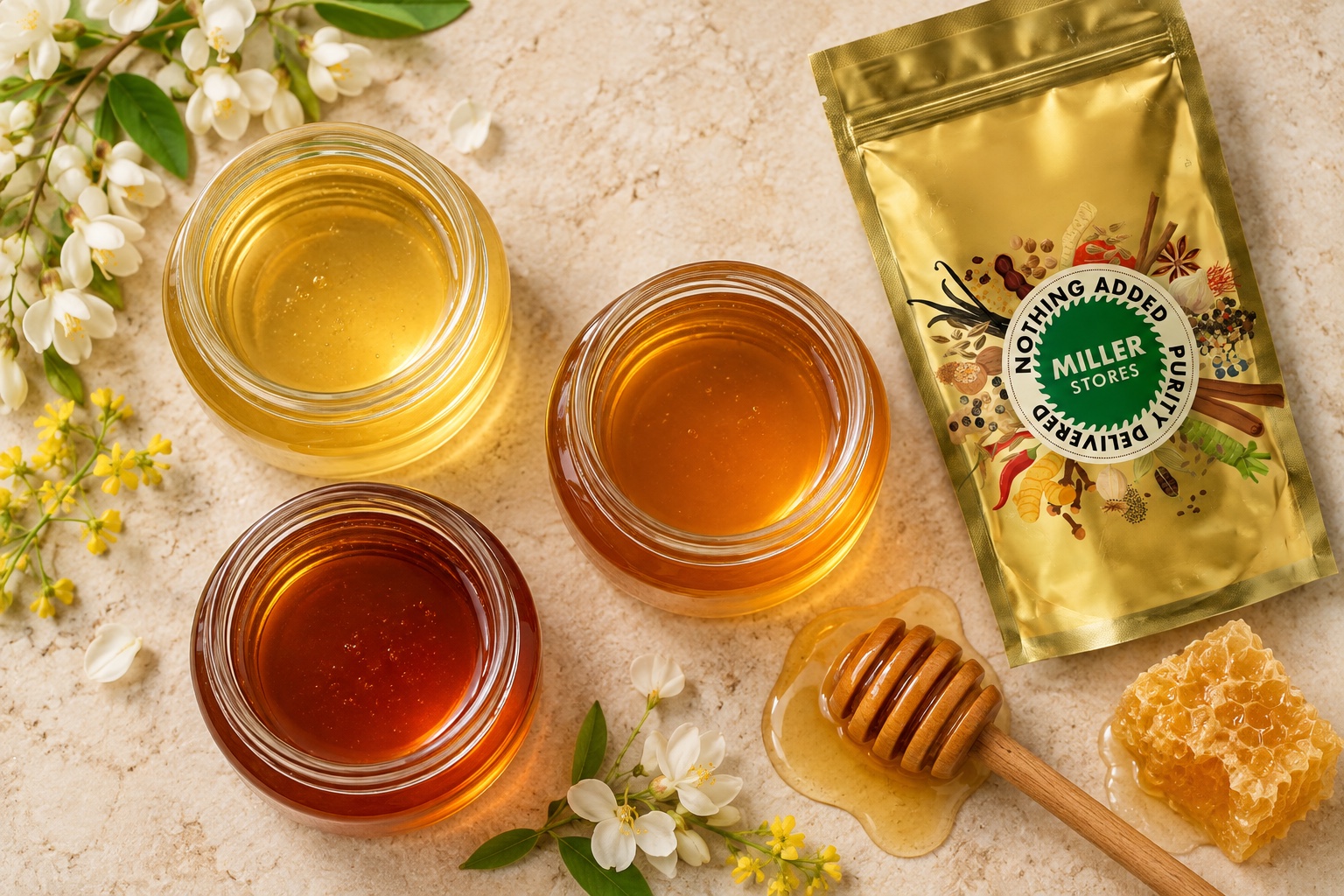
Honey naturally ranges from pale gold to deep amber. Its colour and flavour vary with floral source, season and storage. Darker honey is not automatically purer, and lighter honey is not automatically more processed.
Crystallisation is also normal. Some honeys granulate quickly while others remain liquid for longer because their natural sugar balance and storage conditions differ. Crystals alone do not prove that honey is pure or adulterated. Home tricks involving water, flames, thumbs or ants are not reliable substitutes for laboratory testing.
5. Match the honey to the way you will use it
- Everyday sweetening: choose a mild honey that will not overpower tea, porridge or toast.
- Cooking and marinades: a robust honey can hold its flavour alongside spices, citrus and savoury ingredients.
- Drizzling and tasting: try a clearly identified floral source when you want a distinctive aroma.
- Frequent use: compare price per 100 g, not only the jar price, and buy a size you can store cleanly.
6. Check the pack before buying
Choose a sealed container without leakage, a damaged lid or signs of contamination around the rim. Read the label before comparing price. A traceable jar with clear details is a more dependable purchase than one relying mainly on vague purity claims.
7. Store honey well
Keep the jar tightly closed in a cool, dry place away from direct sunlight. Use a clean, dry spoon so moisture and food particles do not enter the container. Refrigeration is usually unnecessary and can speed up crystallisation.
If honey crystallises, place the closed jar in warm water and stir gently. Avoid excessive heat, which can damage flavour and quality.
A quick buying checklist
- The ingredient list matches the product you want.
- The pack has clear traceability, date and licence information.
- Floral-source and processing claims are specific rather than vague.
- The seal and container are intact.
- The flavour and pack size suit how you plan to use it.
Remember that honey is still a concentrated source of sugar, so use it in moderation. Honey should not be given to infants under 12 months of age.
Reference: Food Safety and Standards Authority of India — Product Standards.